POF vs Glass Fiber vs Electronic Level Sensors: A Complete Buyer's Comparison
Selecting the right liquid level presence sensor requires comparing technologies that look similar on datasheets but behave very differently in the field. A plastic optical fiber (POF) void sensor, glass fiber TIR lens switch, capacitive sensor, ultrasonic rangefinder, and conductive electrode switch all detect liquid presence - but their performance diverges sharply when temperature swings, chemicals attack, EMI surges, or distances stretch. This comparison guide cuts through the marketing language and gives engineers and buyers a clear framework for choosing the right technology.
For POF void detection fundamentals see plastic optical fiber voids as a liquid level presence sensor; for POF wiring and signal conditioning see POF liquid level sensor integration and wiring; for optical level switch fundamentals see optical level switches; for continuous vs point-level sensing see continuous vs point level sensors; for sensor fundamentals see what is a liquid level sensor; choosing the right switch; and the ultimate guide to liquid level switches.
What This Guide Compares
Point-level presence sensors answer a binary question: "Is liquid present at this location right now?" This comparison covers five technologies:
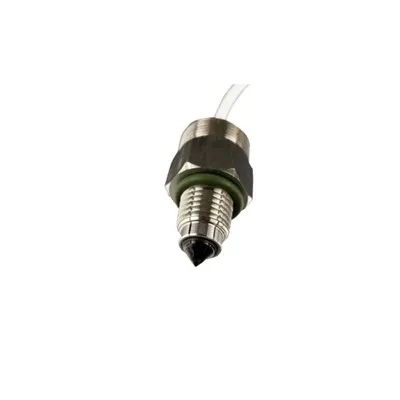
POF void sensor - light leakage at exposed PMMA fiber tip
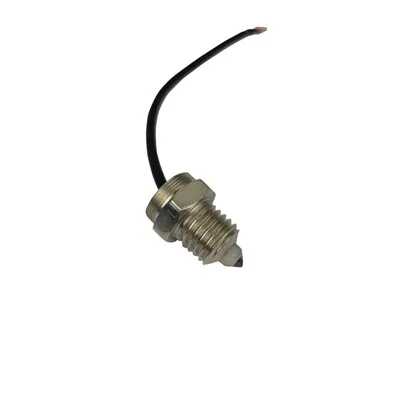
Glass fiber TIR lens switch - precision total internal reflection lens, sharp threshold (e.g., OS3, Optomax, OS-950)
Capacitive electronic sensor - capacitance change at a probe electrode
Ultrasonic point sensor - echo return time at a fixed point
Conductive electrode switch - electrical conductivity between immersed electrodes
Comparison covers principle, robustness, chemical compatibility, temperature and pressure range, EMI immunity, installation complexity, cost, and recommended use cases.
Operating Principles Compared
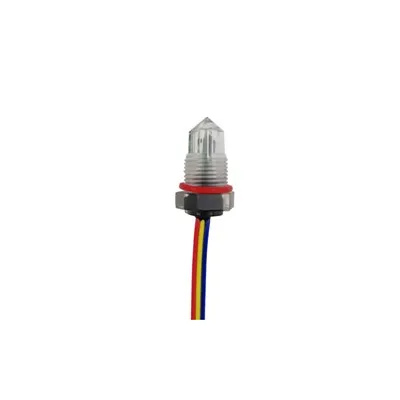
POF void sensor: A 650 nm LED couples light into a PMMA fiber. Liquid at the exposed tip changes the refractive index boundary, causing light to leak. A photodetector measures the drop in received light. This is a gradual leakage effect, not a sharp threshold.
Glass fiber TIR lens switch: A precision lens at the fiber tip reflects light back when in air. Liquid (n ≈ 1.33) breaks total internal reflection, and light escapes. The lens geometry gives a sharp, repeatable threshold. Examples: OS3, Optomax, OS-950 series.
Capacitive electronic sensor: A metal probe forms one capacitor plate; the tank wall or reference electrode forms the other. Liquid or air changes the dielectric constant (air ≈ 1, water ≈ 80). The probe must be in electrical contact with the liquid.
Ultrasonic point sensor: A piezoelectric transducer emits ultrasonic pulses. Liquid at the sensing point returns an echo quickly; void delays or absorbs the echo. Measures time-of-flight and thresholds the result. Non-contact; best in clean liquids.
Conductive electrode switch: Two or more electrodes immersed in liquid. Current flows when liquid conductivity exceeds a threshold, indicating presence. Works only with conductive liquids (water-based, saline, acidic, alkaline). Does not detect pure oils, solvents, or deionized water.
Side-by-Side Comparison Table
| Property | POF Void Sensor | Glass Fiber TIR Lens | Capacitive Electronic | Ultrasonic Point | Conductive Electrode |
|---|---|---|---|---|---|
| Principle | Light leakage at exposed tip | TIR at precision lens | Capacitance change at probe | Ultrasonic time-of-flight | Conductivity between electrodes |
| Contact | None | None | Yes (probe) | None | Yes (electrodes) |
| Robustness | High (flexible) | Low (fragile) | Medium | High | Medium |
| Bend radius | ~10× diameter | Sharp bends break | N/A | N/A | N/A |
| Chemical resistance | Good (avoid strong solvents) | Excellent | Coating-dependent | High (no contact) | Electrode material-dependent |
| Temperature | −40 to +80–85 °C | −40 to +125 °C | −40 to +125 °C | −30 to +70 °C | −40 to +200 °C |
| Pressure | ~10 bar | Up to 200 bar | ~50 bar | Limited | Up to 200 bar |
| EMI immunity | Complete | Complete | Susceptible | Susceptible | Susceptible |
| Spark risk | None | None | Low | None | Possible |
| Run length | 50–100 m | 1,000 m+ | <50 m | <5 m | Hundreds of m |
| Response | Sub-ms | Sub-ms | Medium | Medium | Medium |
| Conductivity required | No | No | No | No | Yes |
| Maintenance | Clean tip; check connectors | Clean lens; inspect fiber | Clean probe; check coating | Clean transducer face | Clean electrodes |
| Cost | Low–medium | Medium–high | Low–medium | Medium | Low |
| Best for | Harsh, EMI, flexible routing | Precision, hazardous, long runs | OEM, general-purpose | Clean, hygienic, non-contact | Conductive aqueous liquids |
Mechanical Robustness and Installation
POF: Standout advantage is mechanical flexibility - the 1 mm PMMA fiber routes through tight bends, multiple 90° conduit turns, and vibration zones where glass fiber fractures. Ideal for retrofits and vibrating equipment. No precision alignment required - the 980 µm core and visible red light make coupling straightforward.
Glass fiber TIR lens: Fragile under mechanical stress - tight bends, crushing, and repeated flexing cause fractures. Properly routed in protective conduit, it is extremely reliable. Lens surface must stay clean; residue degrades the switching threshold.
Capacitive: Probe is the mechanical weak point. Viscous or particle-laden liquids coat the probe, shifting the capacitance baseline. High vibration loosens probe connections.
Ultrasonic point: No liquid contact - only the transducer face needs attention. Must stay free from condensation, foam, and heavy coating. Vibration can loosen mounting.
Conductive: Electrodes corrode over time, especially in AC-powered switches. Viscous liquids coat electrodes with biofilm or sediment. Electrode material must match the liquid chemistry.
Chemical Compatibility
POF: PMMA resists water, dilute acids, dilute alkalis, and most organic solvents. Attacked by strong solvents (acetone, MEK, strong alcohols, chlorinated hydrocarbons). Specify FEP or PFA protective tube for aggressive chemicals.
Glass fiber TIR lens: Glass and stainless steel housing resist a wide range of chemicals. The glass lens surface is highly inert - the strongest chemical resistance of any technology reviewed.
Capacitive: Depends entirely on probe coating. PTFE resists most chemicals but may delaminate; PFA offers better resistance. Uncoated stainless steel probes corrode in chlorides and acids.
Ultrasonic point: Non-contact - chemical resistance limited to transducer face and housing materials. SS316L for aqueous; PVDF or Hastelloy for aggressive environments.
Conductive: Electrode material must match the liquid. SS316L fails in chlorides; Hastelloy C-276 handles most acids and chlorides; titanium resists seawater; tantalum is nearly universal but expensive.
EMI and Hazardous Area Performance
POF and glass fiber TIR lens: Completely immune to EMI - the sensing point transmits only light. Operate reliably near VFDs, motor starters, welding equipment, and radio transmitters. The fiber is intrinsically safe; LED driver and detector electronics still need Ex-rated enclosures (Ex d or Ex i with barrier) but the fiber run through the hazardous area carries no electrical energy.
Capacitive, ultrasonic, and conductive: All three are EMI-susceptible. Capacitive measurements pick up noise from VFDs and AC power lines; ultrasonic pulses are corrupted by EMI; conductive switches are sensitive to stray currents and ground loops. In hazardous areas, all three require Ex-rated enclosures or barriers. The conductive electrode carries the highest spark risk since it applies voltage directly into the liquid.
Signal Run Length
POF: ~0.15 dB/m limits runs to 50–100 m. Each connector adds 0.5–2 dB loss. For longer runs, POF-to-glass fiber media converters add cost.
Glass fiber TIR lens: ~0.5 dB/km enables 1,000 m+ runs. Preferred for campus-wide or multi-building installations.
Capacitive: Cable capacitance limits runs to ~50 m. For longer distances, route digital output (RS-485, IO-Link) instead of raw analog.
Ultrasonic point: Practical for short runs only - a few meters. Sensitive to temperature gradients and acoustic noise.
Conductive: Cable resistance adds negligible error. Runs of hundreds of meters are practical.
Application-Specific Decision Matrix
| Application | Recommended Technology | Second Choice | Avoid |
|---|---|---|---|
| Corrosive chemical tanks | Glass fiber TIR lens, POF | Capacitive (PTFE probe) | Conductive, capacitive (uncoated) |
| Saltwater / marine bilge | POF | Glass fiber TIR lens | Conductive, capacitive |
| Food / beverage CIP verification | POF, glass fiber TIR lens | Ultrasonic point | Capacitive, conductive |
| Underground tank leak detection | POF | Conductive | Glass fiber, ultrasonic |
| Pump dry-running protection | POF | Conductive | Capacitive, ultrasonic |
| Hygienic / pharmaceutical tanks | Glass fiber TIR lens | POF | Conductive, capacitive |
| Electrically noisy environments (VFDs) | POF, glass fiber TIR lens | - | Capacitive, ultrasonic, conductive |
| Long runs (>100 m) | Glass fiber TIR lens | Conductive | POF, ultrasonic |
| Conductive aqueous liquids only | Conductive | POF | - |
| Non-conductive liquids (oils, solvents) | POF, glass fiber TIR lens | Capacitive | Conductive |
| High temperature (>100 °C) | Glass fiber TIR lens | Capacitive (high-temp probe) | POF, conductive |
| High pressure (>50 bar) | Glass fiber TIR lens | Conductive | Capacitive, POF, ultrasonic |
| Tight bend routing / limited space | POF | Capacitive | Glass fiber, ultrasonic |
| OEM / high volume | Capacitive, conductive | POF | Glass fiber TIR lens |
Cost Comparison
POF: Low component cost (LED, phototransistor, comparator). Main cost is custom fiber assembly and connectors. High-volume molded assemblies reduce cost. Installation moderate - fiber routing requires care but no precision alignment.
Glass fiber TIR lens: Medium-to-high cost - precision lens, glass fiber, sealed housing. Integrated modules (OS3, Optomax, OS-950) in medium-to-high range. Installation moderate but fiber routing requires care.
Capacitive: Low-to-medium cost. Many low-cost OEM probes available. Straightforward installation.
Ultrasonic point: Medium cost. Transducers more expensive than LEDs and photodetectors.
Conductive: Lowest component cost - simple electrodes and basic electronics. Main ongoing cost is electrode replacement in corrosive or fouling environments.
FAQ: Choosing Between Technologies
When should I choose POF over a glass fiber TIR lens switch?
Choose POF for tight bends, harsh mechanical environments, constrained budgets, and runs up to 100 m. Choose glass fiber TIR lens when precision threshold, run length over 100 m, or maximum chemical resistance is required.
Can I use a conductive switch in non-conductive liquids like pure water or oil?
No. Conductive switches need liquid conductivity above ~1 µS/cm. Pure water, deionized water, oils, and solvents do not conduct. Use POF, glass fiber TIR lens, capacitive, or ultrasonic instead.
My application has VFDs creating severe EMI. Which sensor won't fail?
POF and glass fiber TIR lens - both are completely immune to EMI at the sensing point. Route fiber in standard cable tray alongside power cables without concern.
I need to detect liquid 200 m from the control room. What are my options?
Glass fiber TIR lens (1,000 m+) or conductive switches. POF is limited to 50–100 m. Capacitive and ultrasonic are not suitable.
The liquid is a strong acid at 90 °C. Which sensor survives?
Glass fiber TIR lens with glass/PTFE/SS316L housing handles strong acids at temperature. Capacitive with PTFE or PFA probe is viable. POF softens at 80–85 °C and is attacked by some acids. Conductive requires Hastelloy or tantalum electrodes.
Which sensor installs in an existing tank without draining?
POF and glass fiber TIR lens install through existing nozzles without draining (housing rated for tank pressure). Ultrasonic mounts externally on sight glasses. Capacitive and conductive usually require probe insertion through a nozzle.
What maintenance does each technology require?
POF: clean fiber tip and connectors annually; check baselines. Glass fiber TIR: clean lens surface; inspect fiber routing. Capacitive: clean probe if fouled; check coating. Ultrasonic: clean transducer face; verify mounting. Conductive: clean electrodes; check for corrosion or coating.
I have a tight budget for 50 sensors. Which technology gives best value?
Conductive aqueous liquids: conductive switches (lowest cost). Non-conductive or harsh environments: POF (best cost-robustness balance). Hygienic or hazardous precision switching: glass fiber TIR lens (higher cost, lower failure rate).
Conclusion
No single technology wins across all applications. The right choice depends on liquid chemistry and conductivity, temperature and pressure, installation environment (mechanical, electrical, hazardous), run length, and budget. For harsh chemical, marine, or electrically noisy environments, POF and glass fiber TIR lens are the clear leaders - both offer complete EMI immunity and intrinsic safety. For conductive aqueous liquids at lowest cost, conductive electrode switches remain the workhorse. For OEM applications, capacitive sensors balance capability and price. Ultrasonic point sensors serve clean hygienic non-contact niches. Use the decision matrix to match technology to application; where two are equally viable, factor in long-term failure rates, maintenance intervals, and spare parts availability. For POF void detection fundamentals see plastic optical fiber voids as a liquid level presence sensor; for POF wiring and signal conditioning see POF liquid level sensor integration and wiring; for optical level switch fundamentals see optical level switches; for continuous vs point-level sensing see continuous vs point level sensors; for sensor fundamentals see what is a liquid level sensor; choosing the right switch; and the ultimate guide to liquid level switches.