The Ultimate Guide to Submersible Liquid Level Sensors
Submersible liquid level sensors are one of those "set it and forget it" tools that quietly keep water systems, tanks, pits, and process lines running smoothly. If you've ever needed to know how full a tank is (without climbing a ladder or guessing), this is the family of water level sensors you'll want to understand.
Below is a practical, no-nonsense level transmitter selection guide for tanks-written for anyone who buys, installs, or maintains liquid level sensors in the real world.
What submersible liquid level sensors are (and where they shine)
Submersible liquid level sensors (also called submersible level transmitters) sit under the liquid surface and continuously measure level. They're popular because they're:
Simple to install (lower it in, secure the cable, wire it up)
Reliable in dirty or foamy liquids where other methods struggle
Great for deep tanks and wells where top-mounted sensors are inconvenient
Common uses include:
Best level sensor for water tank applications (storage tanks, cisterns, towers)
Wastewater lift station level monitoring (pump control, alarms, overflow prevention)
Industrial sumps, rivers, reservoirs, and process tanks
The hydrostatic level sensor working principle (explained simply)
Most submersible units are hydrostatic sensors. The hydrostatic level sensor working principle is straightforward: the deeper the sensor sits, the more pressure the liquid exerts. The transmitter converts that pressure into a level reading.
Think of it like this:
Liquid above the probe = weight pushing down
More liquid height = more pressure
The electronics translate pressure into a signal your PLC/display can read
That's why you'll often see them described as a pressure transducer for liquid level measurement-because that's exactly what they are.
Key components: probe, diaphragm, and cable
A typical setup includes:
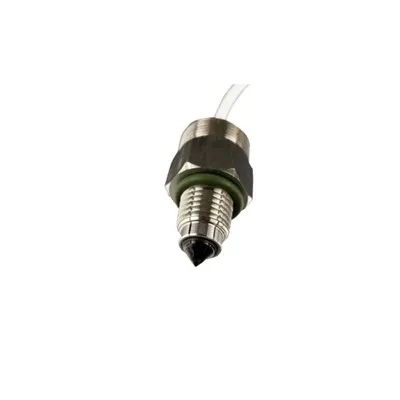
A rugged probe body (often a stainless steel IP68 level probe for harsh environments)
A sensing diaphragm at the tip (the "pressure window")
A cable that carries the signal (and sometimes a vent tube)
Material matters a lot. For water and wastewater, stainless steel is common. For aggressive fluids, you may need a corrosion resistant level sensor for chemicals (special alloys, coatings, or isolating diaphragms).
Vented vs non-vented level transducer: which should you choose?
This decision trips people up, so here's the practical version of vented vs non-vented level transducer selection:
Vented (gauge) transmitters
These use a tiny vent path (often inside the cable) to reference atmospheric pressure. Pros:
Typically more accurate when barometric pressure changes
Easier "direct level" measurement in open tanks
Watch-outs:
The vent path must stay dry and clean-more on that below
Non-vented (absolute) transmitters
These are sealed and measure absolute pressure. Pros:
Better for humid environments where venting is risky
Often preferred when condensation and water ingress are common
Watch-outs:
May require compensation (or accepting small level shifts) as weather pressure changes
If your site is wet, humid, or exposed, non-vented can save headaches. If your tank is vented and you need stable readings through weather swings, vented is often the cleanest option.
How to install a submersible level transmitter (without creating future problems)
Here's how to install a submersible level transmitter in a way that prevents most "mystery" issues:
Pick the right mounting point
Keep it away from inlets, mixers, and falling water that cause turbulence.
Suspend it properly
Don't let it dangle by the electrical conductors alone.
Use a strain relief, hanger, or messenger wire where needed.
Keep it off the bottom
Leave clearance to avoid sludge burying the diaphragm.
Route the cable smartly
Avoid sharp bends, pinch points, and long runs next to VFD motor leads.
Cable vent tube moisture prevention (must-do for vented models)
If you use a vented sensor, cable vent tube moisture prevention is critical:
Use the manufacturer's desiccant/filter at the termination
Mount the desiccant upright and replace it on schedule
Ensure the cable end is sealed from washdown and rain Moisture in the vent tube is one of the fastest ways to get drifting or unstable readings.
Output signals and the 4-20 mA level sensor wiring diagram basics
Most industrial submersible transmitters output 4-20 mA, because it's robust over long distances.
A typical 2-wire loop concept (what people mean by a 4-20 mA level sensor wiring diagram):
Power supply (+) → Transmitter (+)
Transmitter (-) → PLC/indicator analog input (+)
PLC/indicator analog input (-) → Power supply (-)
Quick tips:
Use shielded twisted pair for the signal cable when possible
Ground the shield properly (usually one end only-follow your site standard)
Confirm the PLC input is configured for 4-20 mA, not 0-10 V
Accuracy, calibration, and what "good" looks like in the field
Spec sheets are great, but real tanks are messy. For submersible level sensor accuracy calibration, focus on these practical checks:
Zero check: With the sensor at a known reference (near-empty or a measured depth), confirm the reading.
Span check: Verify at a second known level (mid or high point).
Density note: If the liquid's density changes (chemicals, hot/cold process fluids), level derived from pressure can shift.
For critical applications, keep a simple calibration record: date, known level, indicated level, adjustments made.
Troubleshooting: common issues and quick fixes
If you need to troubleshoot level sensor signal noise, start with the usual suspects:
Electrical noise (VFDs, pumps):
Separate signal wiring from motor power
Add filtering in the PLC (reasonable damping, not so much that alarms lag)
Poor grounding/shielding:
Verify shield termination and ground loops
Vent problems (vented sensors):
Check desiccant condition and moisture intrusion
Mechanical turbulence:
Move the probe or add a stilling well
Drift after storms:
Review lightning protection (next section)
Protection and reliability: don't skip surge defense
Lightning surge protection for level transmitters is worth it if you have:
Outdoor tanks
Long cable runs
Lift stations and remote sites
Use surge protection designed for 4-20 mA instrumentation loops, and bond/ground per your electrical standards. Many "random" transmitter failures are actually surge events.
Choosing the right sensor for your application (quick decision guide)
Use this mini level transmitter selection guide for tanks:
Clean water tank: stainless body, vented or non-vented; prioritize stable mounting
Wastewater lift station: rugged diaphragm protection, non-vented often favored for humidity; consider clog resistance
Chemicals: select a corrosion resistant level sensor for chemicals (verify wetted materials)
Tight spaces or top obstruction: submersible is ideal
Need a non-contact option: consider an ultrasonic level sensor alternative comparison (see below)
Submersible vs ultrasonic: a quick ultrasonic level sensor alternative comparison
Ultrasonic sensors measure from the top by "pinging" the surface. They can be great, but they struggle with:
Heavy foam
Steam/condensation
Turbulence and angled surfaces
Narrow shafts with obstructions
Submersible hydrostatic sensors handle many of those conditions better, but they do require contact with the liquid and good cable practices.
Bottom line takeaway
Submersible liquid level sensors are a dependable, field-proven way to measure level-especially when conditions are dirty, foamy, or deep. Choose vented vs non-vented thoughtfully, install with strain relief and smart cable routing, follow solid 4-20 mA wiring practices, and treat moisture control and surge protection as part of the job (not "nice-to-haves"). Do that, and your water level sensors will run for years with minimal drama.
Estimated word count (body): ~990 words.