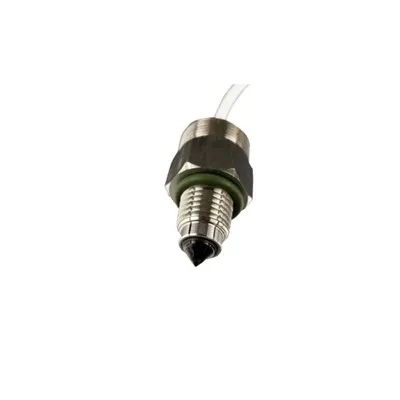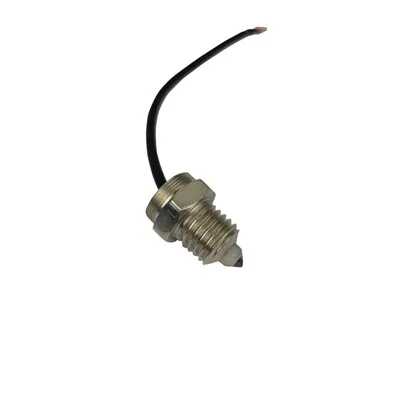
What is a Liquid Level Sensor?
A liquid level sensor is a device that measures how much liquid is in a tank, vessel, sump, or pipe and reports that amount as a height, volume, or percentage. It answers one of two questions: "Is the liquid at this height?" (point-level) or "Exactly how full is it?" (continuous). Level sensors sit at the edge of almost every fluid system - from a washing-machine sump to a refinery storage tank - quietly preventing overflow, dry-run, and out-of-stock conditions. This article is the plain-language primer: what "level" means, how these sensors actually work, the main technology families, and how to pick one. For the broader map, see our ultimate guide to liquid level switches.
Direct Answer
A liquid level sensor detects the position of a liquid surface and converts it into a usable signal. It does this by measuring a physical property that changes with level - distance to the surface, pressure at the bottom, buoyancy of a float, or the capacitance around a probe - and translating that into a reading of height, volume, or % full.
What Does "Liquid Level" Mean?
"Level" is the height of the liquid surface measured from a reference point:
From the bottom up - e.g., "the tank is at 1.2 m."
From the top down - e.g., "there are 30 cm of empty space."
As % full or volume - e.g., "75% full" or "3,000 L."
The sensor almost always measures a height; volume and percentage are calculated from the tank's known geometry. Level matters because liquid systems fail in two ways when it is ignored: overflow (waste, damage, environmental release) and running dry (pump/equipment damage, process stoppage). Inventory, dosing, and billing also depend on knowing the level.
What Does a Liquid Level Sensor Actually Measure?
A level sensor rarely measures "fullness" directly. Instead, it measures a physical quantity that changes with level, then converts it:
| What it measures | Example technology | How it infers level |
|---|---|---|
| Distance to surface | Ultrasonic, radar | Time/signal for echo return → height |
| Hydrostatic pressure | Pressure transducer | Pressure at bottom ∝ liquid height × density |
| Buoyancy / position | Float switch, magnetostrictive | Float follows surface; position read |
| Capacitance | Capacitive probe | Dielectric around probe changes with height |
| Weight | Load cell | Tank weight ÷ density → volume |
| Optical / conductive presence | Optical prism, conductive probe | Liquid at the sensing point changes the signal |
The key idea: level is inferred, not seen. The sensor's calibration turns the raw measurement into a meaningful level value.
From Measurement to Signal: The Signal Chain
A level sensor follows a simple chain: sense → convert → transmit. A transducer senses the physical quantity (echo time, pressure, capacitance), an electronics module converts it to a standardized signal, and the output travels to the controller. In a float switch the "convert" step is just the reed contact closing; in a radar transmitter it is a microprocessor computing level from the echo profile. Understanding this chain explains why a sensor needs calibration (to map raw physics to real height) and why output type (4–20 mA vs digital) matters for the rest of the system.
The Two Fundamental Types: Point-Level vs Continuous
Every liquid level sensor belongs to one of two classes (detailed in our continuous vs point-level guide):
Point-level sensors answer "is the liquid at this specific height?" and output on/off. They control pumps, give high/low alarms, and prevent dry-run. Examples: float switch, optical switch, vibrating-fork, conductive probe.
Continuous sensors answer "exactly how full is it right now?" and output a live value (4–20 mA, digital). They track inventory and process level. Examples: radar, ultrasonic, hydrostatic, capacitive, magnetostrictive.
A float switch is point-level; a radar transmitter is continuous. The choice between them is the first and most important specification decision.
Main Technology Families
| Family | Principle | Best For | Learn More |
|---|---|---|---|
| Float / mechanical | Buoyant float trips a switch or reads position | Simple liquid point-level, pump control | Float overview, product types |
| Hydrostatic / pressure | Pressure at bottom ∝ level | Continuous liquid in closed/open tanks | Measure with pressure |
| Ultrasonic | Sound echo time-of-flight | Clean vented tanks, non-contact | Ultrasonic principle |
| Radar | Microwave echo (free-space or guided) | Harsh, foamy, chemical, high-accuracy | Ultrasonic & radar catalog |
| Capacitive | Dielectric change around probe | Liquids & solids, through-wall | Capacitive complete guide |
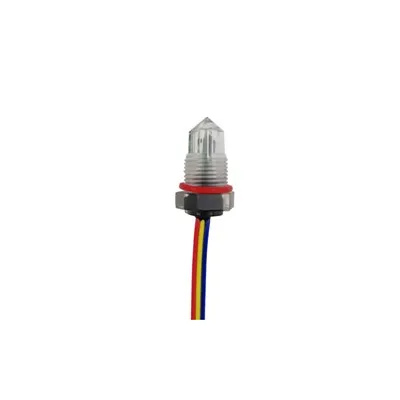
| Optical | Light reflection at a prism | Fast point-level in clean liquids | Optical switches |
| Conductive | Circuit completed by conductive liquid | Conductive liquids, point-level | What sensors indicate level |
Each family trades off cost, accuracy, medium compatibility, and whether the sensor touches the liquid.
Contact vs Non-Contact
A useful way to sort level sensors is whether the sensing element touches the liquid:
Contact (wetted) sensors - float switches, hydrostatic probes, magnetostrictive stems, capacitive probes - have a part inside the liquid. They are often simple and cheap but can foul, corrode, or contaminate.
Non-contact sensors - ultrasonic and radar (above the surface), capacitive through-wall and optical (outside the wall) - never touch the liquid. They suit hygienic, corrosive, or hard-to-penetrate service. Our non-contact sensor guide covers these in depth.
What Are Liquid Level Sensors Used For?
Pump control - start/stop pumps at set levels (float or ultrasonic).
Overfill & dry-run protection - high-level alarms and low-level cutoffs.
Inventory management - continuous level for stock, billing, and reordering.
Process control - maintaining level in reactors, boilers, and dosing systems.
Water & wastewater - lift stations, treatment tanks, reservoirs (water-level sensors).
Safety & environmental - preventing spills and containing hazardous liquids (hazardous locations).
Tank automation - integration with PLCs and SCADA (automation guide).
Key Specifications You Should Know
When reading a datasheet, these fields decide fit:
Measuring range - the min–max level the sensor covers.
Accuracy - how close the reading is to truth (e.g., ±0.25% of span).
Output - 4–20 mA, 0–10 V, relay/contact, or digital (HART, Modbus, IO-Link).
Medium compatibility - wetted material vs the liquid (PP, PVDF, SS316L, Hastelloy).
Pressure & temperature rating - for pressurized or hot tanks.
Ingress protection (IP) - dust/water resistance (IP65–IP68).
Certifications - ATEX/IECEx for hazardous areas, FDA/3-A for food.
Dead band / blanking - the zone near the sensor it cannot read (radar/ultrasonic).
Our selection problems guide explains how these go wrong in practice.
Where Level Sensors Fit in a Control System
A level sensor is almost never the final device - it is an input to a controller. Its signal feeds a PLC, DCS, or SCADA system (or a simple pump controller), which compares the level to set points and drives outputs: start a pump, open a valve, trip an alarm, or log inventory. A point-level float typically connects to a digital input through a relay; a continuous transmitter feeds an analog input or digital bus. The sensor's job ends at delivering an accurate, timely level signal; everything else is control logic. Good tank automation design starts by getting that input right.
How to Choose a Liquid Level Sensor
A short decision path:
Point or continuous? Alarm/pump control → point-level. Inventory/process → continuous.
What is the medium? Water, oil, acid, powder? This fixes material and technology.
Tank material & access - metal (top-mount radar/ultrasonic) vs plastic (through-wall capacitive/optical); can you penetrate it?
Surface condition - calm and clean (ultrasonic OK) vs foamy/turbulent (radar).
Accuracy & budget - radar for high accuracy/harsh service; ultrasonic or capacitive for cost-sensitive clean tanks.
Area classification - confirm ATEX/IECEx if hazardous (IS level switches).
For a full decision framework, see the best way to measure tank level and choosing the right level switch.
Common Misconceptions
"A level sensor measures volume directly." No - it measures height (or pressure/capacitance); volume comes from tank geometry.
"One sensor fits every liquid." False - conductivity, dielectric, density, and chemistry change the right choice.
"A float switch is the only option." Floats are great for simple liquid point-level, but radar, ultrasonic, capacitive, and optical each win in specific conditions (float vs capacitive).
"Non-contact is always better." Not if a cheap contact float does the job reliably and the medium is benign.
"Higher accuracy is always worth it." Only when the process needs it; over-specifying wastes budget.
FAQ: What Is a Liquid Level Sensor?
What is a liquid level sensor in simple terms?
It is a device that detects how high a liquid sits in a container and reports it as a height, volume, or percentage - typically to control a pump, sound an alarm, or track inventory.
How does a liquid level sensor work?
It measures a physical property that changes with level - such as the distance to the surface (ultrasonic/radar), pressure at the bottom (hydrostatic), buoyancy of a float, or capacitance around a probe - and converts that into a level reading.
What is the difference between point-level and continuous?
Point-level sensors report whether liquid is at a set height (on/off). Continuous sensors report the exact level at all times (a live value). The first controls pumps and alarms; the second tracks inventory and process level.
What are the main types of liquid level sensors?
The main families are float/mechanical, hydrostatic (pressure), ultrasonic, radar, capacitive, optical, and conductive. Each uses a different physical principle and suits different liquids and conditions.
Which liquid level sensor is best?
There is no single best. It depends on whether you need point or continuous measurement, the liquid's properties, tank material, surface condition, accuracy, and budget. See our best-way guide.
Can one sensor measure both water and oil?
Often yes for continuous technologies (radar, ultrasonic, hydrostatic), because they respond to height regardless of liquid type - though density affects hydrostatic readings. For interface detection (oil over water), capacitive or some radar methods are used.
What output does a liquid level sensor give?
Point-level devices give a contact (NO/NC/SPDT) or solid-state signal. Continuous devices give 4–20 mA, 0–10 V, or a digital protocol (HART, Modbus, IO-Link) for the PLC or SCADA system.
Are liquid level sensors contact or non-contact?
Both exist. Floats and pressure probes are contact (immersed); ultrasonic, radar, through-wall capacitive, and optical are non-contact. Non-contact suits hygienic or corrosive service.
How accurate are liquid level sensors?
Accuracy ranges from millimeters (radar) to a few percent of span (basic ultrasonic/capacitive). It depends on the technology and how stable the liquid's properties are.
How do I choose the right liquid level sensor?
Decide point vs continuous, identify the liquid and tank, judge the surface condition, set the accuracy and budget, and confirm any hazardous-area certification. Our choosing guide walks through it.
Do liquid level sensors need calibration?
Most need at least a one-time setup: an empty/vessel reference and, for continuous devices, a known full point so the electronics map the raw signal to real height. Stable-medium sensors then run without routine recalibration; switching liquids or large temperature/density shifts may require re-teaching. Float switches typically need only mechanical positioning, not signal calibration.
Can a liquid level sensor fail silently?
Yes - a wrongly specified sensor can stop reporting while appearing intact (e.g., a float that cannot lift in a light liquid, or an ultrasonic blinded by foam). Choosing the right principle for the medium and condition, plus a redundant high-level alarm on critical tanks, prevents silent failure. See our common problems guide.
Conclusion
A liquid level sensor is any device that infers how high a liquid sits and turns that into a useful signal - by measuring distance, pressure, buoyancy, capacitance, or optical presence. The two questions it answers (point or continuous) and the physical principle it uses define the whole technology landscape, from a $10 float switch to a radar transmitter in a chemical sphere. Choose by matching the principle to your liquid, tank, and process - not by habit - and the sensor will do its quiet, critical job for years. For deeper reading, start with our ultimate guide to liquid level switches, the continuous vs point-level guide, and the best way to measure tank level.