Last summer, my neighbor Dave called me in a panic. "Mike, I think my propane tank's been leaking for three days. I forgot to close the valve after grilling on Saturday, and now it's completely empty."
I walked over with my soapy water bottle-the standard test for propane leaks. Sure enough, bubbles formed around the connection point where the regulator met the tank. But here's what shocked me: Dave had lost a full 20-pound tank of propane in just 72 hours. At $3.50 per gallon, that's roughly $17 down the drain (or rather, into the atmosphere).
This wasn't a catastrophic leak. No hissing sound, no strong rotten-egg smell. Just a slow, silent drain that emptied his tank without him noticing.
That got me thinking-how many other people are losing propane without realizing it? And more importantly, what can actually prevent this waste?
The Real Cost of "Forgetting"
Let's be honest here. Most of us have done it. You finish grilling, you're tired, you figure you'll close the valve tomorrow. Tomorrow becomes three days, and suddenly you're standing at the propane exchange station wondering why your tank is empty again.
According to propane safety experts, a standard 20-pound tank maintains around 145 psi at 70°F. Propane is stored as a liquid under pressure-about 36 cubic feet of gas per gallon of liquid. Even a tiny micro-leak at a threaded connection can vent enough gas to drain a full cylinder in less than a week if the pressure remains constant.
The problem isn't just the obvious leaks you can smell. It's the "silent drain"-micro-leaks at regulator fittings, worn O-rings, or hose connections that seep propane slowly enough that you don't notice until the tank's empty.
Thermal expansion makes it worse. During hot days, pressure spikes and forces gas through weak seals. At night, the gas contracts, creating a slight vacuum effect that can pull in moisture. Your system literally "breathes" through imperfect connections, losing fuel volume with each temperature cycle.
I've seen this happen to RV owners too. They store their RVs for months with tanks connected, assuming everything's fine. When they pull the RV out for that first spring trip, the propane gauge reads empty. They assume it's a bad gauge, but the real culprit was a slow leak draining the tank all winter.
Why Traditional Gauges Don't Help
Here's where it gets frustrating. Most RVs and grills come with built-in "gauges" that are about as useful as a weather rock. You know the ones-those vague indicators that show "Full," "Half," or "Empty" but never seem accurate.
I used to have a Camco inline pressure gauge on my grill. Cost me $28. It had a color-coded dial: green for full, yellow for low, red for empty. The problem? Propane pressure stays relatively consistent until the liquid is almost gone-around 10-15% full. That gauge couldn't tell me if I was at 70% or 30%. It only warned me when I was already nearly out.
Pressure-based gauges also get thrown off by temperature. On cold mornings, the dial might show "low" even when the tank's half full. On hot afternoons, it might show "full" when you're actually running low. I learned this the hard way when I thought I had plenty of propane for a camping trip, only to wake up shivering at 2 AM when the furnace died.
The truth is, if you want accurate readings, you need ultrasonic technology-the same tech used in medical imaging and naval sonar. Ultrasonic sensors send sound waves through the tank wall to measure the actual liquid level, not just the pressure.
Smart Monitoring: The Game Changer
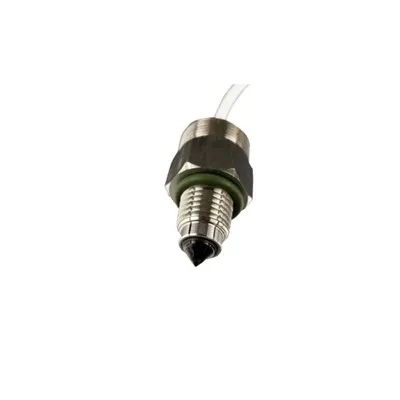
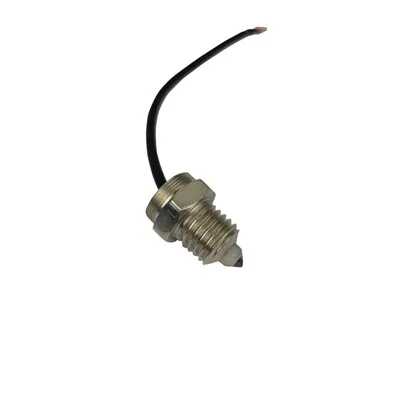
A few months after Dave's incident, I started researching propane tank monitors seriously. That's when I discovered the Smart LPG2412-BT propane level monitor.
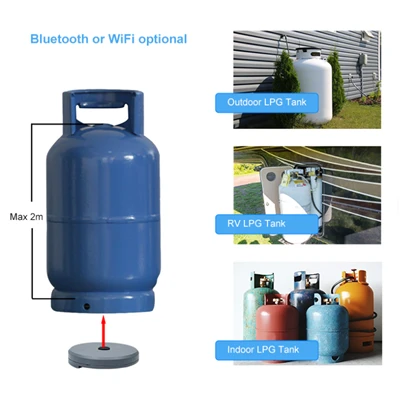
What caught my attention was the approach: instead of threading into the gas line or requiring tank modification, this sensor magnetically attaches to the bottom of the tank. No drilling, no wiring, no risk of creating new leak points.
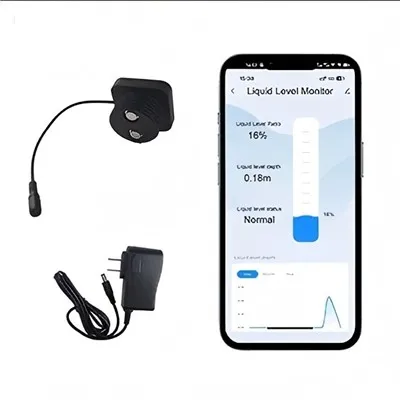
The technology uses ultrasonic waves-similar to how a bat navigates in the dark. The sensor sends a pulse up through the tank wall, the sound wave hits the liquid surface and bounces back, and the device calculates the distance. This gives you an actual percentage reading: 72% full, 45% full, etc.
I tested it on my own 20-pound grill tank. The setup took about 5 minutes:
Download the "Tank IoT" app (free on both Android and iOS)
Turn on my phone's Bluetooth and pair with the sensor
Clean the bottom of the tank with the included coupling agent
Stick the sensor on magnetically
The app immediately showed me I had 68% remaining-4.7 gallons out of a 4.7-gallon tank capacity. I compared this against a scale measurement (weighing the tank and subtracting the tare weight stamped on the collar). The readings matched within 0.1 gallon.
Real-World Scenarios: When This Matters
Let me walk you through where this technology actually changes things.
Scenario 1: RV Camping
My friend Sarah runs a food truck and lives in a 32-foot travel trailer during the summer season. She has dual 30-pound propane tanks that power her furnace, water heater, stove, and refrigerator.
Before smart monitoring, she'd swap tanks based on guesswork-or worse, she'd run out of propane during service. One July evening, she lost power to her refrigeration unit mid-service because the propane tank died. That cost her $200 in spoiled inventory.
Now she uses ultrasonic monitors on both tanks. The app sends her alerts when either tank drops below 20%. She gets about 48 hours' warning before she'd actually run out-plenty of time to schedule a refill without disrupting service.
The monitors cost her $78 total (two units). In one season, they've already paid for themselves by preventing that single food-spoilage incident.
Scenario 2: Home Propane Users
I have another friend, Tom, who lives in a rural area with a 500-gallon propane tank buried in his yard. He heats his home, water, and runs his dryer on propane.
For years, he relied on the tank's built-in float gauge-a mechanical dial on top of the tank. These gauges are notoriously inaccurate. They can stick, float poorly, or give false readings due to temperature changes.
Tom had a scare two winters ago. His gauge showed 30%, but when the delivery truck came, they could only add 200 gallons-meaning the tank had been closer to 60% full. He'd over-ordered and paid for an unnecessary delivery.
He's since installed a Generac LTE monitor that clips onto the existing gauge and transmits readings to his phone via cellular. The device cost $120 plus $2.99/month for LTE service. Over three years, his total cost of ownership is around $190.
But here's the thing: that $190 prevents him from ever running out or over-ordering. One missed delivery in a New York winter could cost him frozen pipes, a hotel stay, and emergency service calls-easily $500 or more. The monitor pays for itself with a single prevented incident.
Scenario 3: Grill Safety
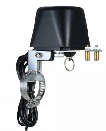
Remember Dave? After his leak incident, he installed a GasStop emergency shut-off valve on his grill. This is an inline device that goes between the tank and regulator. It costs about $60 and does two things:
Monitors pressure through a color-coded gauge
Automatically shuts off propane flow if it detects a major leak
The shut-off feature is critical. If a hose ruptures or a connection fails catastrophically, the valve closes within seconds, preventing a massive propane release. This is especially important for grills stored on decks or near homes.
Dave tested it by intentionally loosening a connection. The valve snapped shut instantly. Now he grills with peace of mind, knowing that even if he forgets to close the tank valve, a major leak won't empty his tank or create a fire hazard.
Installation: Easier Than You Think
One thing I appreciate about modern propane monitors is the installation simplicity. Let me compare:
Inline Pressure Gauges (e.g., GasStop, Camco):
Cost: $25-$65
Installation: 15 minutes, basic tools (two wrenches)
Requires: Turning off tank, bleeding lines, threading into gas line
Best for: Safety-conscious users who want leak detection + shut-off
Ultrasonic Sensors (e.g., Smart LPG2412-BT, Mopeka):
Cost: $60-$130
Installation: 5-10 minutes, no tools required
Requires: Cleaning tank bottom, Bluetooth pairing
Best for: Users who want accurate level readings + remote monitoring
For my grill setup, I run both. The ultrasonic sensor tells me exactly how much propane I have. The GasStop provides emergency shut-off protection. Total investment: $130 for both devices, 25 minutes of installation.
For RVs, I recommend ultrasonic sensors exclusively. You don't want inline devices adding length to your propane compartment where they might interfere with tank covers or travel clearance.
The Smart LPG2412-BT specifically works well because of its compact profile. The sensor is about 2 inches in diameter and sticks up maybe half an inch from the tank bottom. Most RV propane compartments have at least that much ground clearance.
What About Insurance and Other Benefits?
Here's something most people don't consider: propane monitoring can affect your insurance.
Some homeowner insurance policies offer discounts for smart gas detection systems. I checked with my insurer (State Farm) and found that installing a propane leak detector with automatic shut-off qualified me for a 2% discount on my policy. That's about $30 per year on my $1,500 premium.
Over five years, that's $150 in savings-more than covering the cost of a $60 GasStop.
For commercial operations-food trucks, restaurants, rental properties-propane monitoring often isn't optional. Health departments and fire marshals increasingly require documented safety systems. A smart monitor that logs propane levels and alerts you to leaks provides the paper trail inspectors want to see.
There's also the peace of mind factor. I travel frequently for work, and my wife stays home with the kids. Before we had propane monitoring, she'd sometimes worry about the grill tank or the RV's propane system. Now she can check levels on her phone and know exactly where things stand.
If a leak does occur while I'm away, she gets an alert and can call a professional. That's the real value-protection when you're not there to notice problems yourself.
Making the Right Choice for Your Situation
After testing multiple systems and talking to dozens of propane users, here's my straightforward recommendation:
If you're a casual griller: Get a basic inline pressure gauge with leak detection. The DOZYANT or GasSafe models ($15-$30) give you a "low fuel" warning and catch major leaks. You don't need precision percentages-you just need to know when you're almost out and that your system isn't leaking.
If you're an RV owner: Invest in ultrasonic monitoring. The Mopeka Pro Check ($60-$80) or Smart LPG2412-BT ($19-$22 wholesale, $38-$55 retail) gives you accurate readings for trip planning. When you're boondocking or camping remotely, you need to know if you have 3 days of propane or 3 hours.
If you have a large home propane tank: Cellular monitoring like the Generac LTE or Otodata systems. Yes, there's a monthly fee ($2-3/month), but it prevents run-outs and over-orders. For a 500-gallon tank, one avoided emergency delivery saves you $100+.
If you run a business using propane (food truck, restaurant, rental): You need both accurate monitoring AND automatic shut-off. Compliance, safety, and cost control all depend on knowing your propane status 24/7. The total investment for commercial-grade systems runs $200-$300 per tank, which is negligible compared to the cost of a single propane-related incident.
The Bottom Line
Going back to Dave's situation: he lost $17 worth of propane over three days. But the real issue wasn't the money-it was the risk. A slow propane leak in an enclosed space (like under a grill cover or in an RV compartment) can create a flammable vapor cloud.
Propane is heavier than air. It pools in low areas. It only takes a small spark-a pilot light, a light switch, a static discharge-to ignite.
The question isn't really "How much propane is lost?" The question is "How much risk are you willing to accept?"
For me, $60-$80 for a quality monitor is cheap insurance. It prevents waste, eliminates guesswork, and-most importantly-keeps my family safe.
If you have the budget, get the Smart LPG2412-BT or similar ultrasonic monitor. The accuracy alone makes meal planning and trip logistics easier. Pair it with an inline shut-off valve if you want comprehensive protection.
If you're on a tight budget, at least get a basic pressure gauge with leak detection. The $20 you spend could prevent a $200 problem-or worse.
And if you're still leaving your tank valve open "just for a day," stop. Close it after every use. Check for leaks monthly with soapy water. Propane is incredibly safe when managed properly, but it demands respect.
Your future self, standing at a full propane tank on a cold camping night instead of shivering in the dark, will thank you.