How to Check Propane Levels in Your Tank: Complete 2026 Guide to Propane Level Monitoring
In this guide: Everything you need to know about how to check propane levels in your tank - covering the weigh test, built-in float gauges, the hot water trick, smart monitors, pressure gauges, and the complete FAQ guide for 2026.
How to Check Propane Levels in Your Tank: Quick Answer
You can check propane levels in your tank using five primary methods: (1) the weigh test - weigh the tank, subtract the tare weight (stamped "TW" on the collar), divide by 4.2 for gallons remaining; (2) the built-in float gauge on residential tanks (reads 0–100%, accurate to ±15–25%); (3) the hot water trick - pour warm water down the tank, the cold section below the propane line shows the level; (4) a smart propane monitor (Mopeka Pro Check for steel tanks, Generac G0070090 for buried/remote tanks) that sends phone alerts; and (5) a pressure gauge that threads onto the valve. The weigh test is the most accurate (±1–3%) and works on any tank. For hands-off remote monitoring, a smart monitor with a 20% low-level alert is the best solution - you check your phone instead of your tank. The 20% rule applies to all tanks: order a refill at 20–25%, never at empty.
Method 1: The Weigh Test (Most Accurate)
The Gold Standard for Any Tank
The weigh test is the most accurate method to check propane levels in any tank - from a 20-pound BBQ cylinder to a 1,000-gallon stationary tank. It requires no batteries, electronics, or modifications, and beats every gauge on the market.
The Weigh Test Formula
code复制
Propane pounds left = Total weight − Tare weight (TW) Propane gallons left = Propane pounds left ÷ 4.2 lbs/gallon Fill percentage = Propane gallons left ÷ Tank capacity (gallons) × 100
Why 4.2? Propane has a density of approximately 4.2 pounds per gallon at 60°F. This constant is the foundation of all propane weight calculations.
Worked Example - 20-Pound BBQ Cylinder
| Step | Calculation | Result |
|---|---|---|
| Weigh the tank | Bathroom scale | 29.5 lbs |
| Find tare weight | TW on collar | 17.0 lbs |
| Subtract tare | 29.5 − 17.0 | 12.5 lbs propane |
| Convert to gallons | 12.5 ÷ 4.2 | 2.98 gallons |
| Calculate percentage | 2.98 ÷ 4.7 × 100 | 63% full |
Worked Example - 250-Gallon Stationary Tank
| Step | Calculation | Result |
|---|---|---|
| Weigh the tank | Platform scale | 1,200 lbs |
| Find tare weight | TW (stamped) | 520 lbs |
| Subtract tare | 1,200 − 520 | 680 lbs propane |
| Convert to gallons | 680 ÷ 4.2 | 161.9 gallons |
| Calculate percentage | 161.9 ÷ 200 × 100 | 81% full |
Note: 250-gallon tanks hold 200 gallons at 80% fill.
Tare Weights for Common Tanks
| Tank Size | Tare Weight (TW) | Full Weight | Gallons at 80% Fill |
|---|---|---|---|
| 20 lb cylinder | 16.5–18.5 lbs | 36–38 lbs | 4.7 gal |
| 100 lb cylinder | 65–75 lbs | 164–174 lbs | 23.6 gal |
| 250 gal tank | 480–550 lbs | 1,320–1,390 lbs | 200 gal |
| 500 gal tank | 900–1,050 lbs | 2,580–2,730 lbs | 400 gal |
| 1,000 gal tank | 1,700–2,000 lbs | 5,060–5,360 lbs | 800 gal |
Method 2: Built-In Float Gauge
The Standard Residential Tank Gauge
Most residential and commercial propane tanks have a built-in analog float gauge mounted on the tank's service valve or dome. This gauge reads 0–100% and is visible from outside the tank.
How to Read the Built-In Gauge
| Gauge Reading | What It Means | Action |
|---|---|---|
| 75–100% | Tank is well-stocked | No action needed |
| 50–75% | Healthy level | Monitor |
| 25–50% | Moderate | Plan a refill soon |
| 10–25% | Low | Order a refill now |
| 0–10% | Critical | Emergency refill required |
Built-In Gauge Accuracy
Built-in float gauges are accurate to only ±15–25% - most unreliable at the extremes (0% and 100%) and most reliable in the middle range. Tanks are also never filled to exactly 100% - they are legally filled to 80% of water capacity, so a freshly filled tank reads 80% on the gauge.
When to trust the built-in gauge:
For general awareness (is the tank roughly half full?)
As a first check before a cold snap or major appliance use
Combined with a weigh test or smart monitor for precision
When NOT to trust it:
When planning a refill amount (use the weigh test)
In cold weather (gauge reads low due to temperature)
On older tanks (float mechanism may be stuck)
Method 3: The Hot Water Trick
The Best Free Method Without a Scale
The hot water trick is a simple, free way to estimate propane level using only hot water and your hand. It works on any steel or aluminum tank (not plastic/composite).
How to Perform the Hot Water Trick
Heat water to a safe temperature (warm tap water, not boiling)
Pour the hot water down one side of the propane tank, top to bottom
Wait 3–5 seconds
Run your hand slowly down the same side of the tank
The tank feels warm above the propane level (vapor space) and cold below it (liquid propane)
The temperature-change point is the propane liquid surface
Why this works: Liquid propane is extremely cold (boiling at -44°F). Where liquid propane is inside the tank, it rapidly absorbs heat from the warm water, leaving that section cold to the touch. Above the liquid line, only propane vapor is present, which does not absorb heat as effectively, so the tank stays warm.
Accuracy: ±10–15% - good enough to decide "half full or nearly empty" but not precise enough for exact gallons.
Method 4: Smart Propane Monitors
The Hands-Off Remote Monitoring Solution
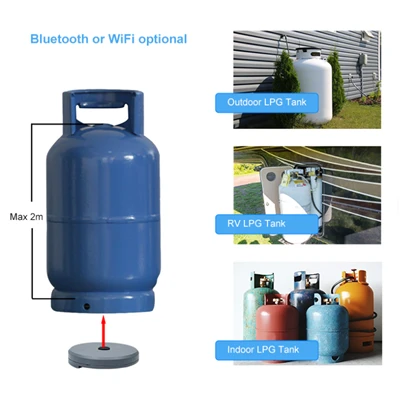
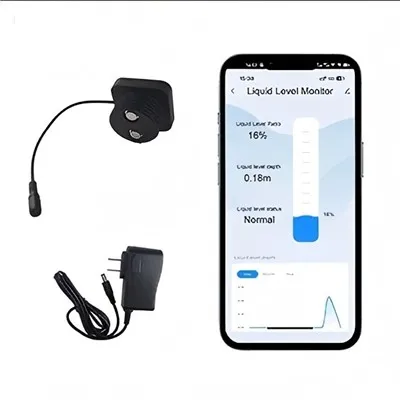
Smart propane monitors attach to your tank and send real-time level readings to your smartphone, with automatic low-level alerts. They eliminate manual checking entirely.
Best Smart Propane Monitors in 2026
| Monitor | Type | Accuracy | Connectivity | Price | Best For |
|---|---|---|---|---|---|
| Mopeka Pro Check | Magnetic ultrasonic | ±3–5% | BLE → Hub → WiFi | $89–$129 | Steel tanks; Home Assistant |
| Generac G0070090 | LTE cellular | ±5–8% | Direct cellular | $199–$249 | Buried/remote tanks; no WiFi |
| Mopeka Standard | Magnetic ultrasonic | ±5–8% | BLE → Hub → WiFi | $74–$109 | Budget smart monitoring |
| Tank Utility | WiFi/cellular | ±5–10% | WiFi or cellular | $99–$149 | Multi-tank monitoring |
How Smart Monitors Work
Magnetic ultrasonic monitors (Mopeka) mount on the bottom of the tank with a built-in magnet. They emit an ultrasonic pulse through the tank wall and measure the distance to the liquid propane surface. The reading is sent via Bluetooth to a Hub, which forwards it to the cloud and your phone app. LTE monitors (Generac) connect directly to the cellular network - no WiFi or Hub required, ideal for buried tanks and remote properties.
Recommended Alert Thresholds
| Alert Level | Percentage | Notification |
|---|---|---|
| Warning | 30% | "Propane running low - schedule a refill" |
| Refill | 20% | "Time to order - tank will be empty in X days" |
| Critical | 10% | "Refill now - tank nearly empty" |
Method 5: Pressure Gauge
Reading Vapor Pressure on a Universal Tank Gauge
A vapor-pressure gauge (like the Universal Tank Gauge 530-0074) threads onto the tank's vapor withdrawal port and reads tank pressure in PSIG. Higher pressure generally indicates a fuller tank, but temperature dramatically affects the reading.
Pressure Reading Interpretation (at 60°F)
| Gauge Reading (PSIG) | Estimated Fill Level | Action |
|---|---|---|
| 0–20 | Very low (0–10%) | Order refill immediately |
| 20–50 | Low (10–25%) | Schedule refill soon |
| 50–80 | Moderate (25–50%) | Monitor closely |
| 80–110 | Half to 3/4 (50–75%) | Normal range |
| 110–140 | 3/4 to full (75–95%) | Good level |
| 140–170 | Full (80%+) | Maximum safe fill |
Critical caveat: Vapor pressure is dominated by temperature, not fill level. The same full tank reads 40–50 PSIG in freezing weather and 180+ PSIG in summer heat. Use pressure gauges only as a directional indicator, never for precise measurements.
Comparison of All Methods
Which Method Should You Use?
| Method | Accuracy | Cost | Effort | Best For |
|---|---|---|---|---|
| Weigh test | ±1–3% | Free (scale) | 5 min | Most accurate; any tank |
| Built-in gauge | ±15–25% | Free (included) | Instant | General awareness |
| Hot water trick | ±10–15% | Free | 5 min | No scale available |
| Smart monitor | ±3–8% | $74–$249 | 5 min install | Hands-off remote monitoring |
| Pressure gauge | ±15–25% | $25–$60 | 15 min install | Directional indicator |
The 20% Rule: When to Order a Refill
Never Wait Until Empty
The single most important habit in propane management is ordering your refill when the gauge reaches 20–25%, never when it reads 0%. Here is why:
Gauge inaccuracy: Built-in float gauges can be off by 15–25%. A tank reading 20% may actually have 10–35% - waiting until 0% risks running completely dry
Delivery lead time: Propane deliveries take 1–7 days depending on supplier and season. Order early to avoid emergency fees
Cold weather consumption: Propane use spikes in winter - a tank that lasts a month in fall may last two weeks in January
Run-out costs: Running a tank completely dry requires a purge and leak test before refill - $75–$200
For smart monitor users: Set your refill alert to 20% and your critical alert to 10%. The monitor will notify you automatically.
For weigh test users: When the scale shows the tank at 20% of capacity, order a refill. Example: a 20-pound cylinder weighing 22.4 pounds (22.4 − 17.0 = 5.4 lbs ÷ 4.2 = 1.29 gal ÷ 4.7 = 27% full) is near the swap threshold.
Frequently Asked Questions
Q1: What is the most accurate way to check propane level in a tank?
The weigh test is the most accurate way to check propane level in any tank (±1–3% accuracy). Weigh the tank, subtract the tare weight (stamped "TW" on the collar), and divide by 4.2 to get gallons remaining. This works on 20-pound cylinders (use a bathroom scale), 100-pound cylinders (use a platform scale), and stationary tanks (use the supplier's tank scale). Smart monitors (Mopeka Pro Check, ±3–5%) are nearly as accurate and far more convenient for hands-off monitoring. Built-in float gauges (±15–25%) and pressure gauges (±15–25%) are useful for general awareness but should never be trusted for precise measurements or refill planning. The hot water trick (±10–15%) is the best free method when no scale is available.
Q2: How do I check propane level without a gauge?
Without a gauge, use the weigh test (most accurate) or the hot water trick (free, ±10–15%). For the weigh test: weigh the tank on any scale, subtract the tare weight, divide by 4.2. For the hot water trick: pour warm water down the tank side, wait a few seconds, then feel for the cold section - that's where the liquid propane is; above it is empty vapor space. For small cylinders, the slosh test (shake and listen for liquid) works as a rough check. For hands-off monitoring without a built-in gauge, install a magnetic smart monitor (Mopeka Pro Check) that sends phone alerts at your preset threshold. The key is to never rely solely on a guessing - the weigh test or hot water trick gives you a real number before you commit to a refill or a cookout.
Q3: Why is my propane gauge not accurate?
Built-in propane gauges are inaccurate (±15–25%) for several reasons: (1) the float mechanism is mechanical and sticks or corrodes over time, especially on older tanks; (2) tank tilt affects the float position; (3) cold weather lowers vapor pressure, making a full tank appear low; (4) the gauge is least accurate at the extremes (near 0% and 100%) by design; (5) tanks are filled to only 80% of water capacity, so a "full" tank reads 80%, not 100%. Additionally, if your gauge reads high while the tank is actually low, the float may be stuck or the gauge may be faulty. For precise level monitoring, use the weigh test (±1–3%) or a smart monitor (±3–8%) instead of relying on the built-in gauge. If the gauge is stuck or erratic, have it inspected by a propane technician.
Q4: How do smart propane monitors check tank levels?
Smart propane monitors check tank levels using ultrasonic or cellular technology. Magnetic ultrasonic monitors (Mopeka Pro Check) stick to the bottom of a steel tank and emit an ultrasonic pulse through the tank wall, measuring the distance to the liquid propane surface - accurate to ±3–5%. The reading is sent via Bluetooth to a Hub, then to your phone app, which shows level, consumption history, and AI-predicted days remaining. LTE monitors (Generac G0070090) connect directly to the cellular network and work without WiFi - ideal for buried or remote tanks. Both send automatic alerts at preset thresholds (set 20% for refill, 10% for critical). The main advantage: you check your phone, not your tank, and you get warned before running out. Most monitors are installed in under 5 minutes with no tank modification.
Q5: How often should I check my propane tank level?
Check your propane tank level according to your monitoring method and usage: (1) with a smart monitor, you are notified automatically at 20% - no manual checking needed beyond occasional app verification; (2) with a built-in gauge, check weekly during heating season and before any major appliance use or cold snap; (3) with the weigh test, check before each significant use (before a cookout for BBQ tanks, monthly for home heating); (4) with the hot water trick, check when you suspect the level is low. The most important check is the one before you need the propane - never wait until the appliance fails to check the level. For home heating, a weekly glance at the gauge plus a smart monitor alert is the minimum safe practice. For BBQ tanks, check before every cookout using the weigh test or hot water trick.
The Bottom Line
You can check propane levels in your tank using five reliable methods. The weigh test is the most accurate (±1–3%) - weigh the tank, subtract the tare weight, divide by 4.2, and you know exactly how many gallons remain. It works on any tank from a 20-pound cylinder to a 1,000-gallon stationary tank. The built-in float gauge gives a general indication (±15–25%) but should never be trusted for precise measurement. The hot water trick is the best free method without a scale (±10–15%). A smart monitor (Mopeka Pro Check for steel tanks, Generac G0070090 for buried/remote tanks) provides hands-off monitoring with automatic 20% alerts so you never run out. A pressure gauge is a useful directional indicator but is dominated by temperature effects. Whatever method you use, follow the 20% rule: order your refill at 20–25%, never at empty. This single habit eliminates emergency run-outs, purge fees, and the inconvenience of running out of propane at the worst possible moment. The weigh test is your most accurate tool; the smart monitor is your most convenient; the 20% rule is your safety net.
Last updated: July 2026
Disclaimer: This guide provides general information about checking propane tank levels for educational purposes. Propane is a flammable gas - always exercise caution when operating, testing, or working near propane tanks and appliances. Never attempt to open, modify, or service a propane system without professional certification. If you smell propane gas, evacuate the area immediately, do not operate electrical devices, and call your propane supplier or 911. This guide is not affiliated with, endorsed by, or sponsored by Mopeka, Generac, or any other referenced manufacturer.