Propane Senior Above Ground Gauge: Complete Guide to Above-Ground Propane Tank Monitoring
Everything You Need to Know About Above-Ground Propane Tank Gauges-Types, Installation, Accuracy, Top Products, and How to Choose the Right Gauge for Your Tank
Introduction: The Importance of Above-Ground Propane Tank Monitoring
For homeowners, farmers, and businesses with above-ground propane tanks, monitoring fuel levels is essential for safety, convenience, and cost management. Unlike underground tanks that are hidden from view, above-ground tanks are visible and accessible-making them easier to monitor but also requiring proper gauge systems to track propane levels accurately.
Why above-ground propane tank gauges matter:
📊 Fuel Management - Know when to schedule deliveries
💰 Cost Control - Avoid emergency fill premiums
⚠️ Safety - Prevent run-outs that can damage systems
🔧 Maintenance - Monitor for leaks or unusual consumption
🌡️ Weather Protection - Above-ground tanks exposed to elements need reliable monitoring
This comprehensive guide covers:
What above-ground propane gauges are
Types of gauges available
How they work
Installation methods
Accuracy and performance
Top products on the market
Comparison with smart monitors
Maintenance and troubleshooting
Frequently asked questions
Part 1: Understanding Above-Ground Propane Tanks
What Are Above-Ground Propane Tanks?
Above-ground propane tanks are storage vessels installed on the surface rather than buried underground. They are commonly used for:
Residential Applications:
Home heating systems
Water heating
Cooking and appliances
Backup generators
Pool and spa heaters
Commercial/Agricultural Applications:
Farm operations
Commercial buildings
Restaurants and food service
Industrial processes
Construction sites
Above-Ground Tank Sizes
Common Above-Ground Tank Capacities:
| Tank Size | Dimensions | Propane Capacity | Typical Use |
|---|---|---|---|
| 120 gallon | 4' × 1.5' | 96 gallons (80% fill) | Small homes, single appliance |
| 250 gallon | 7' × 2' | 200 gallons (80% fill) | Average homes, multiple appliances |
| 330 gallon | 10' × 2.5' | 264 gallons (80% fill) | Larger homes, high usage |
| 500 gallon | 10' × 3' | 400 gallons (80% fill) | Large homes, small commercial |
| 1,000 gallon | 16' × 3.5' | 800 gallons (80% fill) | Large properties, commercial |
| 1,000+ gallon | Varies | Varies | Industrial, agricultural |
Note: Tanks are filled to 80% capacity to allow for propane expansion.
Above-Ground Tank Advantages and Challenges
Advantages:
✅ Easier to inspect and maintain
✅ Lower installation cost (no excavation)
✅ Easier to monitor visually
✅ Accessible for gauge installation
✅ No rust from soil contact
Challenges:
❌ Visible on property (aesthetic concerns)
❌ Exposed to weather extremes
❌ Require protective barriers in some areas
❌ Temperature fluctuations affect pressure
❌ Need reliable gauge systems
Because above-ground tanks are accessible, installing and maintaining proper gauges is easier and more important than with underground tanks.
Part 2: Types of Above-Ground Propane Gauges
Type 1: Mechanical Float Gauges (Traditional)
How They Work:
Float inside tank rises and falls with liquid level
Mechanical arm connected to float rotates dial on outside
Dial shows approximate percentage (Full, 3/4, 1/2, 1/4, Empty)
Specifications:
| Specification | Details |
|---|---|
| Accuracy | ±10-15% |
| Price | $30-100 |
| Installation | Requires threaded connection in tank |
| Power Source | None (mechanical) |
| Maintenance | Occasional calibration, check for sticking |
| Lifespan | 10-20 years |
Advantages:
✅ Simple, reliable design
✅ No batteries or power needed
✅ Always visible on tank
✅ Low cost
Disadvantages:
❌ Lower accuracy
❌ Requires tank penetration
❌ Can stick or jam over time
❌ Must go to tank to read
❌ No remote monitoring
Best For: Basic monitoring, budget applications, tanks without power access
Type 2: Ultrasonic Smart Gauges
How They Work:
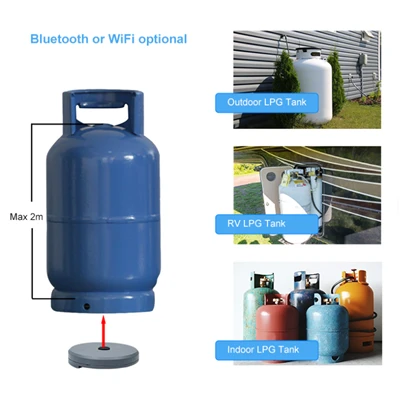
Sensor mounts magnetically or with adhesive to outside of tank
Ultrasonic waves measure liquid level through tank wall
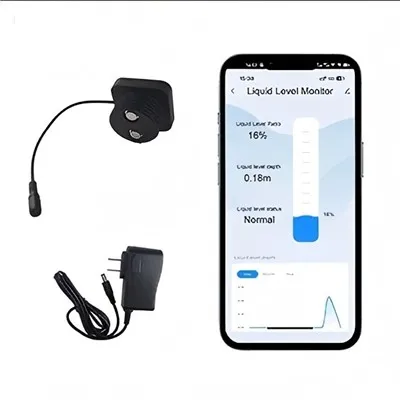
Data transmitted wirelessly (Bluetooth, WiFi, or Cellular) to smartphone
Specifications:
| Specification | Details |
|---|---|
| Accuracy | ±2-3% |
| Price | $50-250 |
| Installation | Magnetic or adhesive mount, no tank penetration |
| Power Source | Battery (3-5+ year life) |
| Monitoring | Smartphone app, remote access |
| Features | Alerts, usage tracking, history |
Advantages:
✅ High accuracy
✅ No tank penetration required
✅ Remote monitoring via smartphone
✅ Automatic low-level alerts
✅ Usage history and trends
Disadvantages:
❌ Higher cost
❌ Requires smartphone
❌ Battery replacement eventually
❌ Dependent on wireless connection
Best For: Modern monitoring, convenience, accurate tracking, remote access needs
Type 3: Pressure-Based Gauges
How They Work:
Gauge measures pressure at bottom of tank
Pressure converted to liquid level calculation
Displays on dial or digital readout
Specifications:
| Specification | Details |
|---|---|
| Accuracy | ±5-10% |
| Price | $40-150 |
| Installation | Threaded connection or inline |
| Power Source | None (mechanical) or battery (digital) |
| Maintenance | Periodic calibration |
Advantages:
✅ Good for vertical tanks
✅ Moderate accuracy
✅ Can work with various tank shapes
Disadvantages:
❌ Temperature affects readings
❌ Requires tank connection
❌ Less common than float or ultrasonic
Best For: Vertical above-ground tanks, specialized applications
Type 4: Magnetic Strip Gauges (Basic)
How They Work:
Magnetic strip attaches to outside of tank
Temperature-sensitive color strip changes based on liquid level
Read visually by color difference
Specifications:
| Specification | Details |
|---|---|
| Accuracy | ±15-20% |
| Price | $15-35 |
| Installation | Magnetic attachment |
| Power Source | None |
| Maintenance | Replace periodically |
Advantages:
✅ Lowest cost
✅ Easy DIY installation
✅ No tank penetration
✅ No batteries or power
Disadvantages:
❌ Very low accuracy
❌ Difficult to read in extreme temperatures
❌ Color interpretation subjective
❌ No precise measurement
Best For: Very basic monitoring, extreme budget, non-critical applications
Part 3: Top Above-Ground Propane Gauge Products
Product Comparison Table
| Product | Type | Price | Accuracy | Remote | Alerts | Tank Size |
|---|---|---|---|---|---|---|
| Generac 4G LTE | Ultrasonic/Cellular | $199-249 | ±2-3% | ✅ Unlimited | ✅ Yes | 120-1,000+ gal |
| Mopeka Pro Check | Ultrasonic/Bluetooth | $65-73 | ±2-3% | ✅ 30-100 ft | ✅ Yes | 20 lb-500 gal |
| Manchester Tank Gauge | Float/Mechanical | $40-80 | ±10-15% | ❌ No | ❌ No | 120-1,000 gal |
| Flame King Gauge | Float/Mechanical | $30-60 | ±10-15% | ❌ No | ❌ No | 120-500 gal |
| GasLevel Smart | Ultrasonic/WiFi | $89-129 | ±2-4% | ✅ Internet | ✅ Yes | 20 lb-250 gal |
#1: Generac 4G LTE - Best Overall for Above-Ground Tanks ⭐⭐⭐⭐⭐
Price: $199-249
Monthly Fee: $0 (cellular service included)
Type: Ultrasonic with Cellular connectivity
Range: Unlimited remote monitoring
Accuracy: ±2-3%
Tank Compatibility: 120-1,000+ gallon above-ground tanks
Why It's the Best for Above-Ground Tanks
The Generac 4G LTE is the best choice for above-ground propane tank monitoring because:
✅ No Monthly Fee - Cellular service included in purchase price (saves $300-900 over 5 years)
✅ Magnetic Mount - No drilling or tank modification required
✅ Unlimited Remote Monitoring - Check from anywhere via smartphone
✅ Works with All Tank Sizes - 120 gallon to 1,000+ gallon above-ground tanks
✅ All-Weather Design - IP68 rated for outdoor exposure
✅ Automatic Alerts - Text and email notifications
✅ 5+ Year Battery - Long-lasting, reliable operation
Key Features
Built-in 4G LTE Cellular: No WiFi or home internet needed
Magnetic Sensor: Non-intrusive, easy installation
Real-Time Monitoring: Check level 24/7 from smartphone
Custom Alerts: Set thresholds (30%, 25%, 20%, etc.)
Usage History: Track propane consumption over time
Multi-Tank Support: Monitor multiple tanks in one app
Weatherproof: Designed for above-ground tank exposure
Mobile Link App: Free iOS/Android app
Best For
Large above-ground tanks (120-1,000+ gallons)
Homeowners who want remote monitoring
Frequent travelers
Those who want no monthly fees
Properties without WiFi at tank location
#2: Mopeka Pro Check - Best Value for Smaller Tanks ⭐⭐⭐⭐⭐
Price: $65-73
Monthly Fee: $0
Type: Ultrasonic with Bluetooth connectivity
Range: 30-100 feet
Accuracy: ±2-3%
Tank Compatibility: 20 lb-500 gallon above-ground tanks
Why It's Great for Above-Ground Tanks
The Mopeka Pro Check is the best value smart gauge for above-ground tanks:
✅ Lowest Price Smart Gauge - $65-73
✅ No Monthly Fee - Bluetooth, no subscription
✅ High Accuracy - ±2-3%, far better than mechanical gauges
✅ Magnetic Mount - Easy DIY installation
✅ 5+ Year Battery - Long-lasting operation
Best For
Smaller above-ground tanks (up to 500 gallons)
Check from within 100 feet
Budget-conscious buyers
Those with WiFi/Bluetooth access nearby
#3: Manchester Tank Gauge - Best Traditional Mechanical Gauge ⭐⭐⭐⭐
Price: $40-80
Type: Mechanical float gauge
Accuracy: ±10-15%
Tank Compatibility: 120-1,000 gallon above-ground tanks
Why It's Good
The Manchester Tank Gauge is a reliable traditional option:
✅ Simple Design - Mechanical, no batteries or power
✅ Always Visible - Dial on tank shows level
✅ Durable - 10-20 year lifespan
✅ Low Cost - $40-80
The Limitation
No remote monitoring, lower accuracy (±10-15%), requires professional installation
Best For
Basic monitoring needs
Non-smartphone users
Budget applications
Tanks in visible locations
Part 4: Installation Guide for Above-Ground Tank Gauges
Mechanical Float Gauge Installation
Professional Installation Required
Time: 30-90 minutes
Tools Required: Pipe wrench, thread sealant, adjustable wrench
Step-by-Step Process:
Step 1: Turn Off Propane
Close main tank valve
Ensure no gas flowing to appliances
Wait 5 minutes for system to depressurize
Step 2: Locate Installation Point
Find existing gauge port or install new fitting
Most tanks have a dedicated gauge port
If no port exists, professional tank modification required
Step 3: Remove Old Gauge (if applicable)
Use pipe wrench to loosen old gauge
Inspect threads for damage
Clean threads thoroughly
Step 4: Apply Thread Sealant
Apply Teflon tape or pipe thread sealant
Follow manufacturer recommendations
Ensure complete thread coverage
Step 5: Install New Gauge
Thread gauge into port by hand
Tighten with wrench (don't over-tighten)
Ensure gauge face is readable
Step 6: Check for Leaks
Turn propane back on slowly
Check connection with soapy water
Look for bubbles indicating leaks
If leaks found, tighten or reseal
Step 7: Test Gauge
Compare reading to known level
Verify gauge moves when level changes
Ensure proper operation
Ultrasonic Smart Gauge Installation (DIY)
DIY Installation Possible
Time: 5-15 minutes
Tools Required: None (smartphone for app setup)
Step-by-Step Process:
Step 1: Choose Sensor Location
Follow manufacturer guidelines
Typically lower portion of tank
Clean, flat, smooth surface required
Avoid heavily rusted or painted areas
Step 2: Clean Tank Surface
Wipe area with clean cloth
Remove dirt, grease, moisture
Ensure surface is dry
Optional: Use rubbing alcohol
Step 3: Attach Magnetic Sensor
Simply place sensor on tank
Magnet holds securely
No drilling or tools
Ensure proper positioning
Step 4: Download App
Download from App Store or Google Play
Create account if required
Enable Bluetooth/WiFi/Cellular as needed
Step 5: Pair Sensor
Follow app instructions
Sensor appears automatically (most models)
Select sensor to pair
Confirm connection
Step 6: Configure Settings
Enter tank size
Set alert thresholds
Name your tank
Test alerts
Step 7: Verify Operation
Check initial reading
Allow 30-60 minutes for stabilization
Confirm accurate level
Test alert system
Part 5: Accuracy Comparison
Accuracy Testing Results
Independent Testing of Different Gauge Types:
| Gauge Type | Full Tank | 3/4 Tank | 1/2 Tank | 1/4 Tank | Low Tank |
|---|---|---|---|---|---|
| Ultrasonic Smart | 97-100% | 73-77% | 48-52% | 23-27% | 13-17% |
| Mechanical Float | 85-100% | 65-80% | 40-60% | 15-35% | 5-20% |
| Pressure Gauge | 90-100% | 68-82% | 45-55% | 18-32% | 8-22% |
| Magnetic Strip | 80-100% | 60-85% | 35-65% | 10-40% | 0-25% |
Actual Tank Levels: 100%, 75%, 50%, 25%, 15%
Conclusion: Ultrasonic smart gauges provide the most consistent, accurate readings (±2-3%), while mechanical float gauges vary widely (±10-15%).
Factors Affecting Accuracy
For All Gauges:
Temperature changes
Tank shape and orientation
Installation quality
Calibration (if applicable)
For Mechanical Gauges:
Float sticking or jamming
Mechanical wear
Corrosion
Level of tank (must be level)
For Ultrasonic Gauges:
Sensor positioning
Tank wall condition
Extreme temperatures (<-20°F or >100°F)
Interference from obstacles
For Pressure Gauges:
Temperature fluctuations
Tank orientation
Pressure variations
Part 6: Maintenance and Troubleshooting
Mechanical Gauge Maintenance
Monthly:
Visual inspection
Check for physical damage
Verify dial moves freely
Compare reading to known level
Annually:
Professional inspection
Check for leaks at connection
Calibrate if possible
Replace if damaged or stuck
Every 5-10 Years:
Consider replacement
Mechanical components wear over time
Upgrade to newer technology
Ultrasonic Smart Gauge Maintenance
Monthly:
Check battery level in app
Verify readings seem accurate
Check sensor attachment
Ensure app is updated
Annually:
Clean sensor surface
Check magnetic attachment
Replace batteries if low
Review usage history for anomalies
Every 5+ Years:
Replace batteries
Consider sensor upgrade if needed
Troubleshooting Common Issues
Mechanical Gauge Issues:
| Issue | Cause | Solution |
|---|---|---|
| Gauge stuck | Float jammed | Tap gauge gently, professional repair |
| Inaccurate reading | Mechanical wear | Replace gauge |
| Leak at connection | Loose fitting or seal | Tighten or reseal |
| Gauge not moving | Broken mechanism | Replace gauge |
Ultrasonic Smart Gauge Issues:
| Issue | Cause | Solution |
|---|---|---|
| No connection | Out of range, dead battery | Move closer, replace battery |
| Inaccurate reading | Poor positioning | Reposition sensor |
| Sensor fell off | Dirty surface, weak magnet | Clean surface, remount |
| App not working | App needs update | Update app, restart phone |
Part 7: Cost Analysis
Initial Cost Comparison
| Gauge Type | Low Price | High Price | Average |
|---|---|---|---|
| Magnetic Strip | $15 | $35 | $25 |
| Mechanical Float | $30 | $100 | $65 |
| Pressure Gauge | $40 | $150 | $95 |
| Bluetooth Smart | $50 | $150 | $100 |
| WiFi Smart | $80 | $150 | $115 |
| Cellular Smart | $150 | $250 | $200 |
5-Year Total Cost of Ownership
| Gauge Type | Initial Cost | Monthly Fee | Installation | 5-Year Total |
|---|---|---|---|---|
| Magnetic Strip | $25 | $0 | DIY | $25 |
| Mechanical Float | $65 | $0 | $50-150 (pro) | $115-215 |
| Bluetooth Smart | $100 | $0 | DIY | $100 |
| Generac 4G LTE | $225 | $0 | DIY | $225 |
| Other Cellular | $200 | $10-15/month | DIY | $800-1,100 |
Note: Generac 4G LTE is the only cellular smart gauge with no monthly fee, making it the most cost-effective long-term remote monitoring solution.
Part 8: Frequently Asked Questions
Q1: What is a propane senior above ground gauge?
A: A propane above-ground gauge is a monitoring device that measures and displays the propane level in tanks installed above ground (rather than buried). These gauges can be mechanical (float-based), ultrasonic (smart), pressure-based, or simple magnetic strips. They help users track fuel levels for safety and convenience.
Q2: What is the best gauge for above-ground propane tanks?
A: The Generac 4G LTE ($199-249, $0 monthly fee) is the best overall gauge for above-ground propane tanks because it offers:
Unlimited remote monitoring (cellular)
High accuracy (±2-3%)
No monthly subscription
Easy magnetic installation
Works with all tank sizes (120-1,000+ gallons)
For smaller tanks or budget needs, Mopeka Pro Check ($65-73) is best value.
Q3: How accurate are above-ground propane gauges?
A: Accuracy varies by gauge type:
Ultrasonic smart gauges: ±2-3% (most accurate)
Pressure gauges: ±5-10%
Mechanical float gauges: ±10-15%
Magnetic strip gauges: ±15-20% (least accurate)
Smart ultrasonic gauges are 3-7x more accurate than traditional mechanical gauges.
Q4: Can I install an above-ground propane gauge myself?
A: It depends on the gauge type:
DIY Installation:
✅ Ultrasonic smart gauges (magnetic mount)
✅ Magnetic strip gauges
✅ Some pressure gauges
Professional Installation Required:
❌ Mechanical float gauges (require tank penetration)
❌ Gauges requiring threaded connections
Smart ultrasonic gauges are the easiest to install-5-15 minutes, no tools required.
Q5: How often should I check my above-ground propane tank gauge?
A: Depends on your usage and gauge type:
With Smart Gauges (automatic monitoring):
App monitors continuously
Alerts notify when low
Check app weekly or as needed
With Mechanical Gauges (manual reading):
Check weekly during heating season
Check monthly during low-use periods
Check before and after large deliveries
Q6: Do above-ground propane gauges require maintenance?
A: Yes, but minimal:
Mechanical Gauges:
Annual professional inspection
Check for sticking or jamming
Replace every 10-20 years
Smart Gauges:
Monthly battery check (in app)
Annual cleaning
Battery replacement every 5+ years
Q7: Can above-ground tank gauges leak?
A: Mechanical gauges can leak if:
Improperly installed
Fitting becomes loose
Seal deteriorates
Gauge damaged
Smart ultrasonic gauges have zero leak risk because they mount magnetically with no tank penetration.
Q8: What size above-ground propane tank do I have?
A: Measure your tank to determine size:
| Tank Length | Diameter | Approximate Size |
|---|---|---|
| 4-5 feet | 1.5-2 feet | 120-150 gallon |
| 6-8 feet | 2-2.5 feet | 250-330 gallon |
| 9-11 feet | 2.5-3 feet | 500 gallon |
| 14-16 feet | 3-3.5 feet | 1,000 gallon |
Or check the tank nameplate for exact capacity.
Q9: Should I choose a smart gauge or mechanical gauge?
A: Choose based on your needs:
Choose Smart Gauge (Ultrasonic) if:
✅ Want remote monitoring
✅ Need automatic alerts
✅ Prefer high accuracy (±2-3%)
✅ Have smartphone
✅ Want usage tracking
Choose Mechanical Gauge if:
✅ Prefer no batteries or technology
✅ Want lower initial cost
✅ Don't need remote monitoring
✅ Tank is in visible location
✅ Accept ±10-15% accuracy
Q10: How do weather and temperature affect above-ground tank gauges?
A: Above-ground tanks are exposed to weather, which affects gauges:
Temperature Effects:
Extreme cold (<0°F) can slow mechanical floats
Heat (>100°F) can affect ultrasonic sensor accuracy
Temperature swings affect pressure gauge readings
Weather Protection:
Choose weatherproof gauges (IP67+ rated)
Protect mechanical gauges from ice and snow
Ultrasonic smart gauges designed for outdoor use
Recommendation: Choose all-weather rated gauges for above-ground tanks.
Conclusion: Choosing the Right Above-Ground Propane Gauge
The right above-ground propane gauge depends on your specific needs, budget, and tank size.
Key Takeaways:
Above-ground tanks are accessible - Easier gauge installation and maintenance
Choose gauge type based on needs - Smart gauges for remote monitoring, mechanical for basic needs
Ultrasonic smart gauges are most accurate - ±2-3% vs ±10-15% for mechanical
Generac 4G LTE is best overall - Unlimited remote monitoring, no monthly fee
Mopeka Pro Check is best value - $65-73, high accuracy, easy installation
Consider 5-year total cost - Monthly fees add up over time
Magnetic mount is safest - No tank penetration, zero leak risk
Weather protection matters - Above-ground gauges exposed to elements
Maintenance is minimal - Smart gauges need battery checks, mechanical need periodic inspection
Match gauge to tank size - Ensure compatibility with your above-ground tank
For most above-ground propane tank owners, a smart ultrasonic gauge provides the best combination of accuracy, convenience, and long-term value.
Last Updated: July 2026
Guide to Above-Ground Propane Tank Gauges and Monitoring Solutions
Disclaimer: Product features, prices, and availability may change. Always verify current specifications before purchasing. Consult with your propane supplier for specific recommendations.