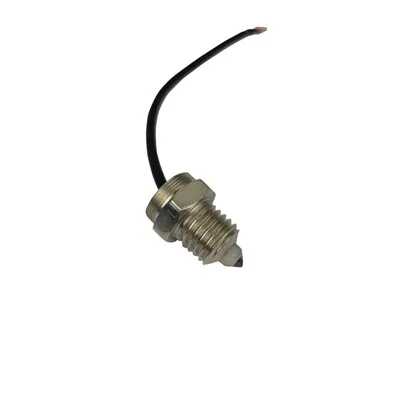
Capacitive Level Sensors: The Complete Guide
A capacitive level sensor measures the presence or height of a material by detecting how that material changes the capacitance of a probe. Because capacitance depends on the dielectric constant of whatever surrounds the probe, capacitive sensors can "see" liquids, powders, granules, pastes, and even the boundary between two liquids - often with no moving parts and, in some designs, without ever touching the product. This complete guide explains what capacitive level sensors are, how they work, the contact and non-contact forms, where they win, and how to select one. For the physics, see our how capacitive sensing works guide; for the catalog context, see capacitive level sensors in the sensors/encoders taxonomy.
What Is a Capacitive Level Sensor?
A capacitor is formed by two conductors separated by an insulator (the dielectric). In a capacitive level sensor, the probe is one conductor and the tank wall (or a reference electrode) is the other; the space around the probe is the dielectric. Air has a low dielectric constant (εr ≈ 1). Most liquids and solids have a much higher εr. As material rises around the probe, the higher-dielectric material replaces air, the capacitance increases, and the electronics convert that change into a level signal.
Two consequences follow:
The sensor detects material presence, not weight or pressure - so it works regardless of the liquid's density.
The reading depends on the material's dielectric constant, which is both its strength (it sees almost any material) and its limitation (if the dielectric changes, the reading shifts).
Capacitive sensors cover both point-level and continuous measurement, and serve liquids and solids - a broader brief than a float switch, which is liquid-only and point-level.
How Capacitive Sensing Works (Brief)
The governing relation is C = ε · A / d, where ε is the dielectric permittivity, A the overlap area, and d the gap. When liquid (high εr) replaces air (low εr) around the probe, C rises in proportion to the covered length. The transmitter measures ΔC and maps it to level.
Two refinements matter in practice:
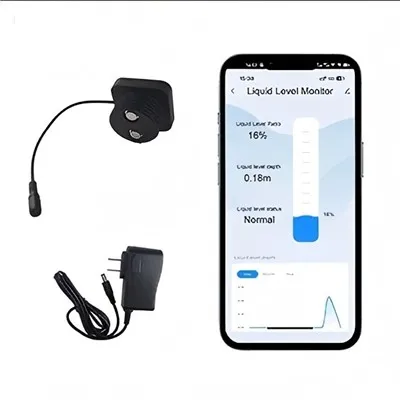
Continuous transmitters measure capacitance along the full probe and output 4–20 mA or digital.
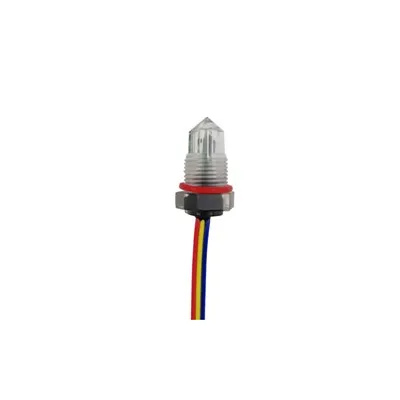
Point-level switches simply trip when capacitance crosses a threshold at one height.
The detailed mechanism, including guard electrodes and signal conditioning, is in our capacitive sensing working-principle guide.
Two Measurement Modes
Point-Level Capacitive Switch
Detects presence/absence of material at a single height and outputs on/off. Ideal for high/low alarms, overfill protection, and pump control in both liquids and bulk solids. See our point-level detection guide.
Continuous Capacitive Transmitter
Measures the level along the probe and outputs a live value. Best for inventory of liquids and some powders where the dielectric is stable. Probe design and setup are covered in our transmitters & probes guide.
Contact vs Non-Contact (Through-Wall)
Contact Probe
The probe is immersed in (or in contact with) the material. Simpler and works in metal tanks, but the probe surface is exposed to coating and abrasion.
Non-Contact (Through-Tank-Wall)
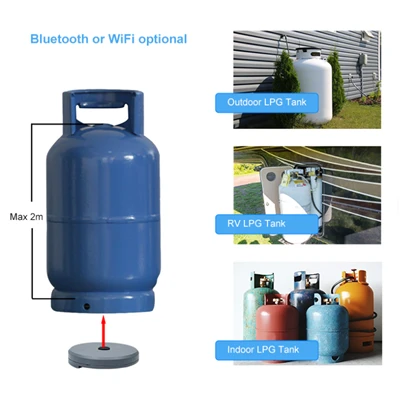
The sensor mounts outside a non-metallic tank (plastic, glass, fiberglass) and measures through the wall. Nothing touches the product - a major hygienic and maintenance advantage. Limited to non-metallic vessels and to materials with sufficient dielectric contrast. Our non-contact measurement guide covers the technique.
RF Admittance - The Coating-Tolerant Variant
Standard capacitive sensing can drift when material coats the probe, because the coating itself adds capacitance. RF admittance (a closely related technology) drives the probe at radio frequency and analyzes both the magnitude and phase of the signal, separating the buildup capacitance from the true level signal. The result: reliable measurement even with sticky, conductive, or coating media such as adhesives, slurries, and pastes. For most industrial coating-prone liquids, RF admittance is the right choice over plain capacitance.
What Capacitive Sensors Measure Well
Liquids - water, oils, fuels, acids, alkalis, solvents (with compatible probe material)
Conductive and non-conductive liquids - capacitance does not require conductivity, unlike conductive probes
Bulk solids and powders - point-level detection of grains, plastic pellets, cement, flour
Pastes and adhesives - especially with RF admittance
Interface detection - the boundary between two liquids of different dielectric constant (e.g., oil over water)
Liquids in non-metallic tanks - via through-wall non-contact sensing
This breadth - liquids and solids, contact and non-contact - is capacitive sensing's signature advantage.
Advantages
No moving parts - solid-state, low maintenance
Through-wall capability - non-contact version measures without penetrating the tank
Liquids and solids - one technology spans both
Coating-tolerant - RF admittance handles sticky buildup
Detects interfaces - oil/water and similar boundaries
Compact and economical - simple probe, low installed cost
Independent of density - unlike hydrostatic pressure, capacitance does not care about specific gravity
Limitations
Dielectric dependence. Accuracy rests on a stable dielectric constant. If the product concentration, moisture, or packing changes (e.g., damp vs dry powder), the reading drifts unless re-zeroed.
Coating (without RF admittance). Plain capacitance drifts under buildup; RF admittance is the fix.
Tank material. Non-contact needs a non-metallic wall. Metal tanks require a contact probe (probe + wall form the capacitor).
Very low-dielectric gases are not detectable - there must be a dielectric contrast.
Temperature effects. Permittivity varies with temperature; high-accuracy service may need compensation.
Probe and Design Options
| Probe Type | Use | Notes |
|---|---|---|
| Rod (rigid) | Clean liquids, short tanks | Simple; easy to clean |
| Cable (flexible) | Deep tanks, powders | Hangs to tank bottom |
| Coaxial | Liquids, coating-prone | Shielded; better RF-admittance performance |
| Ring/disc | Point-level on pipes/vessels | Compact threshold detection |
| PTFE-coated | Aggressive or sticky media | Chemical resistance + anti-stick |
Material is typically stainless steel, with PTFE, PP, or PVDF coatings for chemical compatibility.
Applications
| Application | Mode | Form | Why Capacitive |
|---|---|---|---|
| Water / wastewater alarm | Point | Rod probe | Cheap, no moving parts |
| Oil tank inventory | Continuous | Coaxial probe | Dielectric-based; sees oil |
| Acid / chemical | Continuous | PTFE-coated | Chemically compatible |
| Adhesive / paste | Point/Continuous | RF admittance | Tolerates coating |
| Powder / pellets (point) | Point | Rod/cable | Solids detection |
| Oil-over-water interface | Point/Continuous | Probe | Dielectric contrast |
| Plastic tank (non-contact) | Point/Continuous | Through-wall | No tank penetration |
| Aggressive slurry | Continuous | RF admittance coaxial | Coating-tolerant |
Capacitive vs Other Technologies
| Technology | Best For | Loses to Capacitive When… |
|---|---|---|
| Float switch | Simple liquid point-level, low cost | solids, non-contact need, no moving parts required |
| Radar / ultrasonic | Harshsurface, continuous, non-contact (metal tanks) | non-metallic tank through-wall, low cost preferred |
| Hydrostatic pressure | Continuous liquid, stable density | density varies, or solids |
| Conductive probe | Conductive liquids only | non-conductive liquids or solids needed |
| Vibrating fork | Tough point-level in liquids | solids/powders needed |
Capacitive sensing wins when you need one technology for liquids and solids, optionally non-contact, with no moving parts - provided the dielectric is stable or RF admittance handles the coating. The float-vs-capacitive trade-off is detailed in our industrial float vs capacitive guide.
Selection Checklist
Before specifying a capacitive level sensor, confirm:
Material type - liquid, solid, paste, or interface
Dielectric constant (or contrast) - is it stable? Is there enough contrast vs air?
Point or continuous - switch or transmitter
Tank material - metal (contact probe) vs non-metallic (through-wall possible)
Coating tendency - choose RF admittance if sticky
Chemical compatibility - probe coating (PTFE/PP/PVDF/SS)
Temperature and pressure - probe and electronics ratings
Output - relay/switch, 4–20 mA, or digital
Hygiene - through-wall or easy-clean probe for sanitary service
Accuracy need - dielectric stability must support it
For the broader decision across all level technologies, see our best way to measure tank level and continuous vs point-level guide.
Installation and Commissioning Tips
Capacitive sensors are quick to install but need correct setup to read true:
Calibrate empty first. With the vessel empty (or the probe in air), perform the zero/empty teach so the electronics reference the air dielectric.
Teach the full point. For continuous transmitters, fill to a known level and teach the span so capacitance maps correctly to height.
Account for coating during teach. If RF admittance is used, the teach should occur on a clean probe; the phase separation then tolerates later buildup.
Ground the tank properly. A stable earth reference reduces electrical noise, especially in metal tanks and near VFDs.
Keep the probe clear of obstructions. Baffles, agitators, or nearby metal can distort the field; maintain the recommended standoff.
Re-verify on product change. Because reading depends on dielectric, switching to a different liquid or powder requires re-teaching.
For system-level design, see our level switches for tank automation guide.
FAQ: Capacitive Level Sensors
How does a capacitive level sensor work?
It forms a capacitor between a probe and the tank wall. When material (higher dielectric constant than air) surrounds the probe, capacitance rises; electronics convert the change into a level signal. The full mechanism is in our working-principle guide.
Can a capacitive sensor measure through the tank wall?
Yes - the non-contact version mounts outside a non-metallic tank (plastic, glass, fiberglass) and senses through the wall, with no product contact. Metal tanks require a contact probe. See non-contact measurement.
Do capacitive sensors work for solids and powders?
Yes, especially for point-level detection of grains, pellets, cement, and flour. Continuous measurement of solids is possible but more sensitive to packing and dielectric variation.
What is RF admittance, and why does it matter?
RF admittance is a capacitive variant that analyzes the phase of the signal to separate coating/buildup capacitance from the true level. It tolerates sticky, conductive, or coating media that would drift a plain capacitive sensor.
Does coating ruin a capacitive sensor?
Plain capacitance drifts under coating. RF admittance largely cancels coating effects. For heavy buildup, choose RF admittance with a coaxial or PTFE-coated probe.
Do they work for both conductive and non-conductive liquids?
Yes. Capacitive sensing depends on dielectric constant, not conductivity - unlike conductive probes, which only work in conductive liquids.
Can capacitive sensors detect an oil-water interface?
Yes. Because oil and water have different dielectric constants, the probe sees the boundary between them, enabling interface detection and separate level measurement of layered liquids.
How accurate are capacitive level sensors?
Accuracy is good when the dielectric is stable - typically within a few percent of span for continuous transmitters. If the product's dielectric changes (concentration, moisture, temperature), recalibration or compensation is needed.
Can capacitive sensors be used in metal tanks?
Yes, with a contact probe: the probe and the metal wall form the capacitor. Non-contact through-wall sensing requires a non-metallic tank.
Are capacitive sensors better than float switches?
It depends. Capacitive sensors have no moving parts, handle solids, and can be non-contact - advantages over floats. Floats are often cheaper for simple liquid point-level and are fail-safe mechanical. The trade-off is in our float vs capacitive guide.
Can capacitive level sensors be used in hazardous (explosive) areas?
Yes. Certified intrinsically safe and explosion-protected capacitive sensors exist for ATEX/IECEx zones, including through-wall and RF-admittance variants. As with any technology, the device must carry the correct zone, gas group, and temperature-class certification, and the circuit needs a matched barrier. For the certification vocabulary, see our hazardous-location level guide.
Do capacitive sensors need calibration?
They need a one-time teach (empty and, for continuous, full). Dielectric-stable products then need no routine recalibration, but switching to a different material - or significant temperature/concentration change - requires re-teaching.
Conclusion
Capacitive level sensors are the versatile all-rounders of level detection: one solid-state technology that measures liquids and solids, point and continuous, and - in through-wall form - without touching the product at all. Their superpower is dielectric sensitivity; their caveat is dielectric stability, which RF admittance and careful material selection manage. Choose capacitive when you need no moving parts, non-contact measurement through a plastic tank, interface detection, or a single sensor type across liquids and bulk solids. For simple, low-cost liquid point-level, a float switch may still win; for harsh-surface continuous measurement in metal tanks, radar or ultrasonic may be better. Match the technology to the dielectric, the tank, and the coating - and capacitive sensing will deliver reliable, maintenance-light level detection.
For deeper reading, see our how capacitive sensing works, capacitive transmitters & probes, non-contact measurement, point-level detection, float vs capacitive comparison, and the ultimate guide to liquid level switches.