

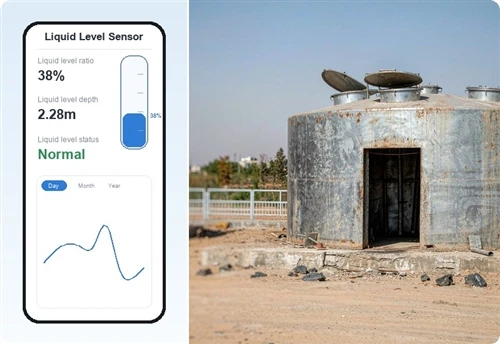
The worst commissioning I have attended involved a sensor mounted on a lid that opened upwards. Every time the tank was inspected, the zero point moved. The reading was correct until somebody did their job. We moved the head to a fixed bridge plate and the 'intermittent fault' disappeared permanently. What follows is the working checklist we use before quoting digital wifi tank gauge for fish farm ponds and tanks.
Most projects in fish farm ponds and tanks are sold on the price of the box and paid for on the cost of the callbacks. Sensors do not fail in a laboratory way. They fail on a Friday night, at the worst level, with the alarm silenced by whoever was on shift. The pattern is the same in every market we sell into: the device is blamed first, the installation is examined last, and the installation is usually where the fault started.
Why Fish Farm Ponds and Tanks is Harder Than It Looks
The difference between a good and a bad installation in fish farm ponds and tanks is usually decided before the sensor is unpacked. Power and network availability decide the model more often than range does. We have specified units for fish farm ponds and tanks on four continents and the failures cluster around the same three things: access, power and surface conditions. A site in Minas Gerais looked straightforward until the rainy season arrived and the tank level rose faster than the alarm delay. Confirm the medium's temperature range and whether foam, steam or solids are present. The cheapest digital wifi tank gauge on a quotation is rarely the cheapest one to own, and the difference shows up in year two.
What the Range Figure Actually Means
Range is the easiest number to quote and the easiest one to misread: it describes the best case, not your tank. Accuracy is quoted as a percentage of full scale, so a 10 m unit at plus or minus 0.5 percent is plus or minus 50 mm at the top of its span, not 5 mm. An overflow alarm set inside that invisible zone never triggers, which is exactly the failure that costs a buyer his maintenance budget. A contractor in Tampere ordered 10 m units for 9.4 m tanks, mounted them hard against the lid, and lost the top 350 mm of every tank to the dead band. Size the digital wifi tank gauge so that your highest alarm point sits at least 100 mm below the bottom of the blanking band. The trade uses several names for this - wifi propane tank monitor, wifi oil tank gauge - and all of them mean the same job of turning a physical level into a number somebody can act on. If your enquiry uses a term like 'wifi propane tank monitor' instead of digital wifi tank gauge, a competent supplier quotes the same thing; a weak one quotes whatever is on the shelf.
Network Design for Tank Rooms and Basements
The question is not whether the site has WiFi, but whether it has WiFi where the tank is. Look for a unit that buffers locally, so a nine hour outage becomes a gap in the graph rather than a gap in the data. We shipped a batch into a basement plant room in Medellin where the signal at the tank was minus 88 dBm; an external antenna on a one metre lead moved it to minus 66 and the callbacks stopped. Do a site survey with a phone at the exact mounting point, at the height of the head, and record the RSSI in the commissioning notes. On fish farm ponds and tanks, the digital wifi tank gauge is doing two jobs at once: it protects the asset and it produces the number your reporting depends on.
From Reading to Decision
Data ownership is a commercial question disguised as a technical one. Alerts need recipients, thresholds, delays and an escalation path; a siren that fires on every ripple trains people to ignore it. We have seen alarms configured at 95 percent with a zero delay, which produced forty notifications a night during filling and got the app muted within a week. Configure alerts with a delay of at least 30 seconds and a repeat interval, so a single splash does not become a false alarm. Any digital wifi tank gauge worth its price tells you when it has lost the echo instead of holding the last good number forever. On fish farm ponds and tanks, the digital wifi tank gauge is doing two jobs at once: it protects the asset and it produces the number your reporting depends on.
What the Price Actually Covers
Two quotations for the same digital wifi tank gauge usually differ by more than the margin on the box. Add labour: a callback on a rooftop tank can cost more than the controller itself, and a callback on a remote farm costs a day. We price our own units on a five year view: one battery change on a solar node, one gasket kit, one spare per fifty installed. When a project buyer asks for the cheapest option, we quote it - and we also quote the version we would install on our own site, with the difference explained line by line. Keep 2 to 5 percent spares per project; the freight on a single replacement unit is brutal.
Accuracy You Can Prove
The difference between a calibrated unit and an uncalibrated one is usually 20 to 60 mm, which is the difference between a comfortable margin and an overflow. Set the full reference against a dip tape or a sight glass, never against the tank's nominal height. On a cylindrical tank lying horizontally, a linear height-to-volume conversion produces big volume errors near the ends; you need the actual strapping table. We ask every customer for a photo of the dip tape next to the reading during commissioning, and it has settled more disputes than any warranty clause. For volume output, load the tank's strapping table rather than relying on a geometric formula.
What we would put in the purchase order
Confirm the tank's internal height with a tape, not with the drawing.
Calibrate at empty and full against a dip tape, then check the mid-point.
Agree who can mute an alarm, and what happens when they are not there.
Decide the reporting interval from the power budget, not from curiosity.
Record the blanking distance and keep the top alarm below it.
Keep one spare unit and one gasket set per twenty installed.
Ask for the register map and pin the firmware version for the project.
Questions buyers ask before they commit
How to choose digital wifi tank gauge for fish farm ponds and tanks
The honest answer is that three numbers decide most projects: the usable range after the blanking distance, the output your panel can read, and the power available on site. Everything else - app, colour, packaging - is negotiable. Write those three into the enquiry and any competent supplier will quote you something you can actually install.
Digital wifi tank gauge price for fish farm ponds and tanks
Expect the ex-works price to be the smallest line in your project budget. Bracket, cable, surge device, commissioning time and the spare ratio all sit on top. When a quotation looks twenty percent cheaper, check what was left out, because it is usually the mounting kit or the surge protection, and both come back as a site visit.
What should I put in the enquiry to get an accurate quotation?
Tank height and diameter, medium and temperature, headroom above the lid, power available, output required, network coverage and quantity. Seven lines. With those, a supplier can quote without guessing, and you can compare offers that describe the same thing.
About the supplier behind this guide
fineherc supplies ultrasonic and WiFi level controllers to integrators, distributors and project buyers in more than forty countries. Our engineers handle the specification review, the register map and the commissioning questions themselves, which is why most of our orders come from customers who have bought before. You can see the current range and the register maps at fineherc.com; if a model does not fit your tank, we say so.
If you are specifying fish farm ponds and tanks and want a second opinion before you commit, send us the tank drawing, the medium and the output you need. Our engineers answer quotation requests within one working day, and they will tell you honestly if ultrasonic is the wrong principle for your site.

Get the datasheet and a quote
Talk to the fineherc team about your unit project - send the tank height, the medium, the supply and the quantity, and you will get a specification review, not a brochure.





