High-temperature Level Sensors
In this guide: High-temperature level sensing for both liquids and bulk solids - the shared heat problem, the unique challenge of hot solids and dust, which technologies survive heat for each phase, applications from boilers to molten metal, a liquid-vs-solid comparison, selection, and the complete FAQ. (For the liquid-only focus, see High Temperature Liquid Level Sensors.)
High-temperature Level Sensors: Quick Answer
High-temperature level sensors measure the level of hot material - liquid (hot oil, boiler water, process fluid) or bulk solid (hot sand, cement, sinter, molten salt, even molten metal) - where the sensor's temperature rating, not the level physics, is the limit. For liquids, the survivors are stainless float switches (~200 °C), optical with a glass tip (~+125 °C), capacitive, vibrating fork, radar with a separated antenna (~200 °C+), remote-seal pressure, and fiber-optic. For hot bulk solids, non-contact radar and nucleonic (gamma) dominate because they ignore heat and dust; high-temp rotating paddle or vibrating-fork (solids type) serve as point switches. The hotter and dustier the material, the more you need a non-contact method with the brain kept away from the heat - radar, nucleonic, or remote-seal/fiber designs.
The Shared Heat Problem
Package, Not Physics
What heat attacks:
| Part | Fails By |
|---|---|
| Plastic body | Softens / melts |
| Seal / O-ring | Hardens / leaks |
| Cable | Degrades |
| Electronics | Drifts / dies |
| Mechanical | Seizes / wears hot |
Same root cause as liquids: Whether the material is liquid or solid, heat kills the package first. The sensing principle still works - microwaves still reflect, capacitance still changes, gamma still attenuates - but the plastic softens, the seal hardens, the cable degrades, and the local electronics drift or die. So high-temp sensing, for both phases, is a packaging problem solved by hot-rated materials and by keeping the sensitive circuit cool (remote electronics, separated antenna, cooling neck, or fiber link). (See High Temperature Liquid Level Sensors for the liquid detail.)
Liquids at High Temperature
Recap of the Liquid Survivors
Liquid-phase options:
| Technology | Hot Ceiling* | Note |
|---|---|---|
| Stainless float | ~200 °C | 316 SS + seal |
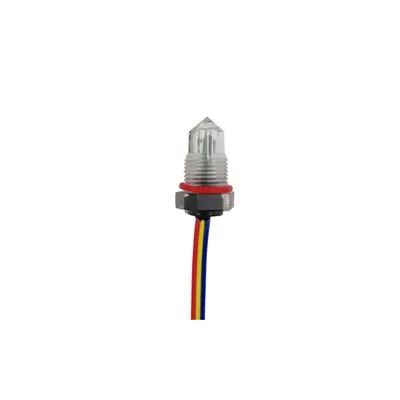
| Optical (glass tip) | ~+125 °C | Tip + ASIC |
| Capacitive (probe) | ~150–200 °C+ | Probe material |
| Vibrating fork | ~150–280 °C | Piezo / fork |
| Radar (sep. ant.) | ~200 °C+ | Antenna separated |
| Pressure (remote seal) | Very high | Tx kept cool |
| Fiber-optic | Very high | Glass fiber limit |
*Varies by model - confirm the datasheet.
Liquids are well served: For hot liquids, stainless float switches (FLOWLINE Switch-Tek class, verified ~200 °C), optical with a glass tip (extended ~+125 °C), capacitive and vibrating-fork probes, radar with a separated ceramic antenna, remote-seal hydrostatic pressure, and fiber-optic all survive. The choice hinges on temperature, pressure, contact tolerance, and point-vs-continuous need. (Full detail and ceilings: High Temperature Liquid Level Sensors.)
Solids at High Temperature
The Hot, Dusty Challenge
Why solids are harder:
| Factor | Effect |
|---|---|
| Dust | Blocks sight / coats |
| Angle of repose | Uneven surface |
| Abrasion | Wears probes |
| Heat | Cooks electronics |
| Buildup | False level |
Solids add dust and abrasion: Hot bulk solids (sand, cement, sinter, ash, biomass, salt) bring problems liquids don't: airborne dust that blinds a sight path and coats probes, an uneven angle-of-repose surface, abrasive flow that wears any inserted probe, and sticky buildup that reads a false high level. Radar and nucleonic ignore all of these by measuring from above through the dust and heat; point switches must be rugged and often high-temp rated. (See Which Sensors Can Be Used for Water Level Measurement for the phase contrast.)
Technologies for Hot Solids
Survive Dust and Heat
Solid-phase options:
| Technology | Hot / Dust | Use |
|---|---|---|
| Non-contact radar | Immune | Continuous, silo |
| Nucleonic (gamma) | Immune | Continuous, harsh |
| Rotating paddle (HT) | Point | High-temp bin |
| Vibrating fork (solids) | Point | High-temp hopper |
| Capacitive (solids) | Buildup risk | Point, clean |
Non-contact wins for solids: For hot bulk solids, non-contact radar is the default continuous choice - its microwave passes through dust and heat, and a separated high-temp antenna keeps the brain cool. Nucleonic (gamma) level measurement ignores heat, dust, abrasion, and buildup entirely, making it the last resort for the most hostile vessels. For point switching, a high-temperature rotating paddle or a solids-type vibrating fork survives where a standard probe would seize or wear. Capacitive works for solids but buildup on the probe is a chronic false-reading risk.
Extreme: Molten and Molten Salt
When It Gets Hostile
| Material | Temp | Typical Sensor |
|---|---|---|
| Molten salt (thermal) | ~290–565 °C | Radar / remote-seal |
| Hot asphalt | ~150–200 °C | Radar / high-temp |
| Molten metal | ~660 °C (Al) + | Nucleonic / radar |
| Slag / clinker | Very high | Nucleonic |
The harshest duty: Molten salt (used in concentrated-solar thermal storage, ~290–565 °C) and hot asphalt (~150–200 °C) are measured with radar (separated high-temp antenna) or remote-seal pressure. Molten non-ferrous metal (aluminum ~660 °C, zinc ~420 °C) and clinker/slag push past what contact probes tolerate, so nucleonic (gamma) or non-contact radar with an extreme-rated antenna is used. At these temperatures, contact is abandoned - only non-contact, with the electronics far from the heat, survives. (See the high-temp liquid article for the lower range.)
Liquid vs. Solid Comparison
One Table, Two Phases
| Factor | Hot Liquid | Hot Solid |
|---|---|---|
| Top methods | Float, radar, pressure | Radar, nucleonic |
| Dust issue | Low | High |
| Abrasion | Low | High |
| Surface | Flat | Uneven (repose) |
| Point switch | Float / fork / optical | Paddle / fork (solids) |
| Extreme (>500 °C) | Remote-seal / fiber | Nucleonic / radar |
| Buildup | Moderate | High |
Pick by phase and hostility: Hot liquids are served by many contact and non-contact options; hot solids lean hard on non-contact (radar, nucleonic) because dust and abrasion defeat inserted probes. The more extreme the temperature and the dustier the material, the more you abandon contact entirely. A flat hot liquid can use a stainless float; a dusty 500 °C silo needs nucleonic or radar.
Materials and Cooling
Build Hot, Stay Cool
Survival toolkit:
| Tool | Use |
|---|---|
| 316 SS / Hastelloy | Hot, corrosive bodies |
| Ceramic antenna | Radar, heat-proof |
| High-temp seal | FFKM / metal |
| Remote electronics | Brain away from heat |
| Cooling neck | Air gap + fins |
| Waveguide / fiber | Length the path |
Same toolkit, both phases: Hot-rated metals (316 SS, Hastelloy, Inconel), ceramic radar antennas, FFKM or all-metal seals, and the core trick of separating the hot probe from the cool brain - remote electronics, a cooling neck with finned air gap, a waveguide that lengths the radar path, or a fiber link that puts only glass at the tank. Whether liquid or solid, the rule is identical: hot at the tip, cool at the circuit.
Applications
From Boiler to Kiln
| Application | Phase | Choice |
|---|---|---|
| Boiler / hot water | Liquid | Side float, radar |
| Hot oil / thermal fluid | Liquid | SS float, capacitive |
| Cement / kiln | Solid | Radar, nucleonic |
| Sinter / sinter plant | Solid | Radar, nucleonic |
| Molten salt storage | Liquid | Radar, remote-seal |
| Molten metal | Liquid | Nucleonic, radar |
Across the plant: Boilers and hot-oil loops use stainless floats or radar; cement kilns and sinter plants use non-contact radar or nucleonic through the dust and heat; molten-salt thermal storage uses radar or remote-seal pressure; molten metal uses nucleonic or extreme-rated radar. The pattern is consistent - the hotter and dustier, the more non-contact and remote the sensor.
Selection Guide
Decide Phase, Then Heat
| Question | Points To |
|---|---|
| Liquid or solid? | Liquid → many; Solid → radar/nucleonic |
| Real temperature? | Match ceiling + margin |
| Dust / abrasion? | Non-contact (radar/nucleonic) |
| Contact OK? | No → radar / nucleonic / remote-seal |
| Point or continuous? | Paddle/fork (point) vs radar (cont.) |
| Brain remote? | Yes → protect electronics |
Phase first, then heat: First decide liquid or solid - that alone sorts you toward floats/optical (liquid) or radar/nucleonic (solid). Then match the real temperature with margin, and if dust or abrasion is present, go non-contact. Decide point vs. continuous, and wherever possible keep the electronics remote so heat never reaches the circuit. Both phases share the same survival toolkit; only the dominance of dust and abrasion differs.
Frequently Asked Questions
Q1: What are high-temperature level sensors used for?
They measure the level of hot material in a process - hot liquids (boiler water, thermal oil, process fluid, molten salt) and hot bulk solids (sand, cement, sinter, ash, biomass). In liquids the heat is the main enemy; in solids, heat plus dust, abrasion, and uneven surface make it harder. Applications run from boilers and hot-oil loops through cement kilns and sinter plants to molten-salt thermal storage and molten metal. The sensor's temperature rating - not the level principle - is what limits the install.
Q2: What is the difference between high-temp sensors for liquids versus solids?
For hot liquids you have many options - stainless float switches, optical with a glass tip, capacitive, vibrating fork, radar, remote-seal pressure, fiber-optic - because the surface is flat and there is little dust. For hot bulk solids, dust and abrasion defeat most inserted probes, so non-contact methods dominate: radar (immune to dust and heat) and nucleonic/gamma (ignores heat, dust, abrasion, and buildup). Point switching in solids uses a high-temp rotating paddle or solids-type vibrating fork. In short, liquids get choice; solids get non-contact.
Q3: Which level sensor works at the highest temperature?
The highest ceilings come from sensors that keep electronics away from the heat. For liquids, remote-seal hydrostatic pressure and fiber-optic reach extremely high temperatures (the transmitter or fiber sits at ambient while only the diaphragm or glass sees the process). For solids, nucleonic (gamma) measurement ignores heat entirely - the source and detector are outside the vessel. Non-contact radar with a separated high-temp ceramic antenna also reaches past 200 °C. Contact probes (float, fork, capacitive) top out lower, typically ~200–280 °C by build.
Q4: Why is radar preferred for hot bulk solids?
Because its microwave passes straight through dust and heat, and a separated high-temp antenna keeps the electronics cool. Hot solids generate airborne dust that would blind a sight path or coat an inserted probe, plus abrasion that wears any probe in the flow. Radar measures from above, unaffected by dust, angle of repose, or abrasion, and reports continuous level. Nucleonic is the alternative for the most hostile vessels where even radar's antenna would suffer. Contact probes simply do not survive hot, abrasive, dusty solids.
Q5: How do you protect the electronics from high temperature?
By separating the hot sensing point from the cool brain. Fiber-optic does this by default (only glass at the tank). Remote-seal pressure uses a diaphragm at the process linked by a capillary to an ambient transmitter. Radar uses a separated ceramic antenna with a waveguide that lengths the path. Even a simple cooling neck - a finned air gap - drops the temperature enough to protect local electronics. The universal rule: hot at the tip, cool at the circuit. Confirm both the temperature and the seal/material rating against the datasheet.
The Bottom Line
High-temperature level sensors measure the level of hot material - liquid or bulk solid - where the sensor's temperature rating, not the level physics, is the constraint. For hot liquids, survivors include stainless float switches (~200 °C), optical with a glass tip (~+125 °C), capacitive, vibrating fork, radar with a separated antenna (~200 °C+), remote-seal pressure, and fiber-optic. For hot bulk solids, dust and abrasion make non-contact essential: radar (immune to dust and heat) and nucleonic/gamma (ignores heat, dust, abrasion, and buildup) dominate, with high-temp rotating paddle or solids vibrating-fork for point switching. The hotter and dustier the material, the more you abandon contact and keep the brain cool via remote electronics, separated antenna, cooling neck, waveguide, or fiber. Decide phase first (liquid → choice; solid → non-contact), then match the temperature with margin. (For the liquid-only focus, see High Temperature Liquid Level Sensors.)
Last updated: August 2026
Disclaimer: This guide surveys high-temperature level sensing for liquids and bulk solids for educational and specification-reference purposes. Temperature ceilings cited are typical/verified anchors, not universal limits: stainless float switches (e.g., FLOWLINE Switch-Tek class) ≈ −40 °C to 200 °C / 34.5 bar; optical with glass tip (SST Optomax-class) ≈ +125 °C extended; ultrasonic electronics commonly capped near 80–120 °C; radar, capacitive, vibrating-fork, remote-seal pressure, and nucleonic ceilings vary widely by model and option. Molten-salt (~290–565 °C), asphalt (~150–200 °C), aluminum (~660 °C), zinc (~420 °C) figures are representative process temperatures, not sensor ratings. Exact ratings, seal materials, and media compatibility must be confirmed against the official datasheet and applicable standards before selection or installation. Brand/model names are trademarks of their respective owners; this guide is not affiliated with or sponsored by any manufacturer.