How Does a Water Sensor Work Physically?
A water sensor works physically by exploiting a measurable physical property that changes with water level or water presence - then converting that change into an electrical signal. Different sensors use different laws of physics: a float uses buoyancy (Archimedes), a pressure sensor uses hydrostatic head (P = ρgh), a capacitive probe uses dielectric contrast (water's high permittivity), an optical switch uses total internal reflection, an ultrasonic or radar sensor uses wave travel time, a conductive sensor uses ion conduction, and a vibrating fork uses a resonant-frequency shift. The common chain is always: physical effect → transduction → conditioned electrical output. This article explains the physics of each method; for choosing between them see how sensors detect water level and the water sensor types guide.
The Universal Transduction Chain
Every water sensor performs three physical steps:
Sense - a physical quantity changes with water (force, pressure, capacitance, light, echo time).
Transduce - that change becomes an electrical quantity (resistance, voltage, frequency).
Condition & output - electronics scale it to 4–20 mA, 0–10 V, NPN/PNP, or IO-Link. For output/signal detail see 12V/24V precision sensors.
What differs is step 1 - the law of physics doing the real work. Example: a float senses buoyancy (step 1), a magnet closes a reed (step 2), and the PLC reads on/off (step 3); a pressure sensor senses head pressure (step 1), a strain-gauge cell outputs mV (step 2), and electronics scale it to 4–20 mA (step 3). Same chain, different physics.
1. Buoyancy - The Float (Archimedes)
A float rides the water surface. Its physics is Archimedes' principle: the upward buoyant force equals the weight of displaced fluid, F = ρ × g × V. The float rises only if water's density (ρ) beats the float's; makers quote a minimum specific gravity (SG) (often ~0.8). At setpoints a sealed magnet in the float actuates a reed switch or microswitch. The "return difference" (hysteresis) comes from the magnet's pull-in vs drop-out field. Full mechanical/electromagnetic detail: float switch how it works and float overview.
2. Hydrostatic Pressure (P = ρgh)
Water has weight, so pressure at the bottom grows with height: P = ρ × g × h, where ρ ≈ 1000 kg/m³ for fresh water, g ≈ 9.81 m/s², h the water height. At the bottom, a pressure (hydrostatic) sensor reads that pressure and infers h. Every 1 m of water ≈ 9.81 kPa (≈ 0.098 bar). The catch: height depends on density, so diesel or syrup gives a different height for the same pressure - enter the correct ρ. Deep dive: measuring level with pressure.
3. Capacitance (Dielectric Contrast)
A probe and the tank wall form a capacitor, C = ε × A / d. Air has low permittivity (εr ≈ 1); water has high permittivity (εr ≈ 80). As water rises around the probe, the average ε between the plates rises, so C increases - the sensor maps capacitance to level. This works point or continuous and tolerates coating when implemented as RF admittance (which separates the coating capacitance by phase). See the capacitive complete guide and float vs capacitive.
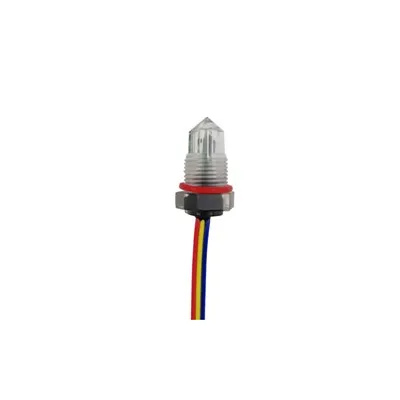
4. Optical - Total Internal Reflection (TIR)
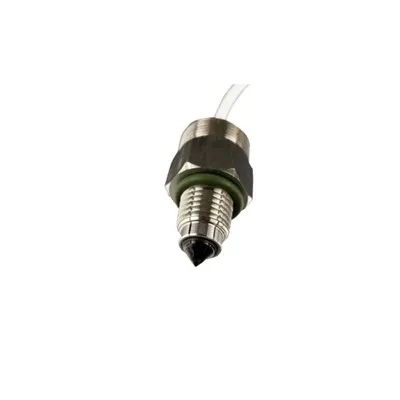
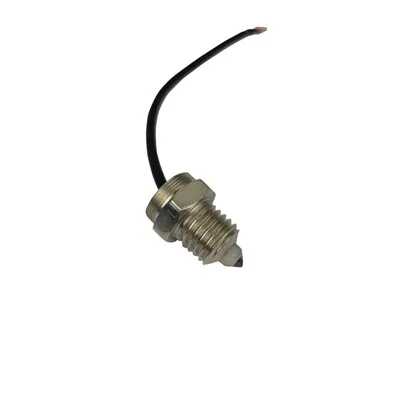
A plastic prism tip carries an infrared LED and photodetector. In air, the tip's geometry causes total internal reflection - the IR bounces back to the detector (state = dry). When water wets the tip, the light's angle now exits into the watery medium (εr high, refractive index matched), so the detector sees a sharp drop and the electronics report "wet." No moving parts; the switch is the optical state transduced to NPN/PNP. Principle deep dive: how optical sensors work and optical switches for liquids/tanks.
5. Ultrasonic - Sound Wave Travel Time
A transducer fires an ultrasonic pulse downward; it reflects off the water surface and returns. Knowing the speed of sound in air (c ≈ 343 m/s at 20 °C) and the round-trip time t, the distance to the surface is d = c × t / 2. Subtract from the tank height to get level. Non-contact, but temperature changes c (compensate with a temperature sensor) and foam/ vapor can scatter the echo. See ultrasonic working principle and ultrasonic sensors.
6. Radar / Microwave - EM Travel Time
Like ultrasonic but using radio waves at the speed of light (c ≈ 3×10⁸ m/s). A radar transmitter emits a microwave, which reflects off the water surface (the dielectric contrast between air and water reflects energy) and returns; level = f(travel time). Radar is unaffected by air temperature, vapor, or dust, and is very accurate (±1–2 mm typical). Non-contact (free-space) or guided-wave (probe as waveguide). See the non-contact sensor hub.
7. Conductive / Resistive - Ion Conduction
Water conducts electricity (dissolved ions carry current); air does not. Two or more electrodes at setpoints complete a circuit only when conductive water bridges them - the sensor detects continuity. Simple and cheap, but only works on conductive liquids (not deionized water) and only as a point switch. It is the resistive counterpart to the optical/capacitive methods above.
8. Vibrating Fork - Resonant Frequency Shift
A piezo-driven tuning fork vibrates at a fixed resonant frequency in air. When water (or any liquid/solid) contacts the fork, the added mass loading and damping shift and attenuate the vibration; the electronics detect the change and switch. Robust for point level in water, sludge, and powders. The physics is mechanical resonance, not optics or buoyancy.
Worked Physics Examples
Hydrostatic. A tank holds 2.0 m of fresh water. Bottom pressure P = ρgh = 1000 × 9.81 × 2.0 ≈ 19,620 Pa ≈ 19.6 kPa (≈ 0.196 bar). A 0–0.2 bar sensor at 4–20 mA reads ~19.6/20 × 16 + 4 ≈ 19.7 mA → ~2.0 m. Change the fluid to diesel (ρ ≈ 835) and the same pressure means h ≈ 2.35 m - density matters.
Ultrasonic. The module measures a round-trip time of 12 ms to the surface. Distance d = c·t/2 = 343 × 0.012 / 2 ≈ 2.06 m (at 20 °C). At 40 °C, c ≈ 355 m/s, so d ≈ 2.13 m - a ~3% error if temperature isn't compensated. This is why ultrasonic sensors include a temperature probe.
Energy & Power
Active methods (optical, ultrasonic, radar, capacitive, conductive) need a supply (often 5–24 V). A reed-float is passive - it is just a contact, so the controlled circuit supplies the energy; only the relay/PLC input current flows through it. Knowing this avoids the common mistake of powering a load directly from a sensor.
Which Physics for Which Water?
| Method | Physical Law | Best Water Condition |
|---|---|---|
| Float | Buoyancy (Archimedes) | Clean/mild, needs SG margin |
| Pressure | Hydrostatic P = ρgh | Submerged, known density |
| Capacitive | Dielectric εr contrast | Conductive or non-conductive, coating-tolerant (RF) |
| Optical | TIR at prism | Clear liquids, tiny cavities |
| Ultrasonic | Sound time-of-flight | Non-contact, open, calm surface |
| Radar | EM time-of-flight | Harsh, vapor/dust, high accuracy |
| Conductive | Ion conduction | Conductive water only, point |
| Vibrating fork | Resonance shift | Point, dirty/sludge-tolerant |
For point vs continuous see point vs continuous; for the full taxonomy see the level sensor complete guide.
Physical Pitfalls to Watch
Density change (pressure/capacitive): wrong fluid density → wrong level.
Temperature shifts speed of sound (ultrasonic) and slightly density (pressure).
Foam / vapor / dust scatter ultrasonic/optical signals; radar handles these better.
Coating on a probe fools capacitance/optical; use RF admittance or non-contact.
Dielectric assumption (capacitive/radar): very low-εr media reflect weakly.
Conductivity assumption (conductive): deionized water won't complete the circuit.
Confirm the right physics for your water with the datasheet guide and choosing the right switch.
From Physics to Control
The sensor's physical effect becomes a usable signal through conditioning: a float reed drives a relay; a pressure cell outputs 4–20 mA; a capacitance oscillator outputs frequency; an optical/ultrasonic/radar module outputs NPN/PNP or digital. The controller compares it to setpoints to run pumps and alarms - see tank automation. In hazardous areas, the transduction must sit in a certified housing (hazardous guide).
FAQ: How a Water Sensor Works Physically
What physical principle do water sensors use?
Different ones: buoyancy (float), hydrostatic pressure (P = ρgh), dielectric capacitance, optical total internal reflection, sound/radio wave travel time, electrical conduction, or mechanical resonance.
How does a float sensor work physically?
Archimedes' buoyancy lifts a float; a magnet in it trips a reed/microswitch at setpoints. It needs a minimum liquid specific gravity.
How does a pressure water sensor work?
It reads bottom hydrostatic pressure P = ρgh and infers height; 1 m of water ≈ 9.81 kPa for fresh water.
Why does density matter?
Pressure and capacitance methods assume fluid density/permittivity; the wrong value gives a wrong level.
How does an optical water sensor work?
Infrared totally reflects inside a dry prism tip but escapes into wet liquid, so the detector sees a change and switches - no moving parts.
How does ultrasonic measure water level?
It times a sound pulse's round trip to the surface (d = c·t/2) and subtracts from tank height; temperature affects sound speed.
How is radar different from ultrasonic?
Radar uses radio waves at light speed (immune to air temp/vapor/dust); ultrasonic uses slower sound and is affected by those.
What is capacitive water sensing?
The probe's capacitance rises as water (high εr ≈ 80) replaces air (εr ≈ 1) around it; the change maps to level.
Does a water sensor need electricity?
Most do (optical, ultrasonic, radar, capacitive, conductive). A reed-float is a passive contact but still needs a circuit to act on it.
Why won't my conductive sensor see pure water?
Deionized water has too few ions to conduct; use optical, capacitive, or float instead.
What physically fails in dirty water?
Coating on probes (capacitive/optical) and debris jamming floats; radar or RF admittance handle fouling better.
How accurate is each method physically?
Radar is typically most accurate (±1–2 mm); float is coarse (setpoint); pressure/ultrasonic are good but density/temp-limited.
Can one sensor use two physics?
Some combines a continuous method with a point switch (e.g., radar plus an NPN alarm), but the core sensing is one physical law.
What is hysteresis, physically?
A small difference between the level where the switch turns on vs off, set by the magnet's pull-in/drop-out field (float) or a deliberate electronic band (optical) - it stops chatter at the threshold.
Why does temperature affect ultrasonic but not radar?
Ultrasonic uses sound speed in air, which rises ~0.6% per °C; radar uses light speed in air, which is essentially constant, so temperature barely matters.
How do I pick the right physics?
Match the law to your water: clean/clear → optical or float; known density → pressure; harsh/dusty → radar; conductive only → conductive; coating → RF admittance or non-contact.
Conclusion
A water sensor is, at its core, a translator of physics into electrical signal. The float exploits buoyancy, the pressure sensor hydrostatic head (P = ρgh), the capacitive probe dielectric contrast (εr ≈ 80 for water), the optical switch total internal reflection, ultrasonic and radar wave travel time (sound vs light speed), the conductive sensor ion conduction, and the vibrating fork mechanical resonance. Each method's accuracy and limits trace directly to its governing law - density for pressure, sound speed for ultrasonic, dielectric for capacitive/radar, refractive index for optical. Choose the physics that matches your water's properties (density, conductivity, clarity, fouling), confirm it on the datasheet, and the sensor will reliably turn "how high is the water?" into a number your controller can act on. Understanding the governing law also tells you exactly what will go wrong - and how to compensate - before you install it.
For more, see how sensors detect water level, water sensor types, what a water level is, water level units & conversion, what is a liquid level sensor, float how it works, pressure method, capacitive guide, optical principle, ultrasonic principle, non-contact hub, level sensor complete guide, point vs continuous, tank automation, hazardous guide, and the ultimate guide.