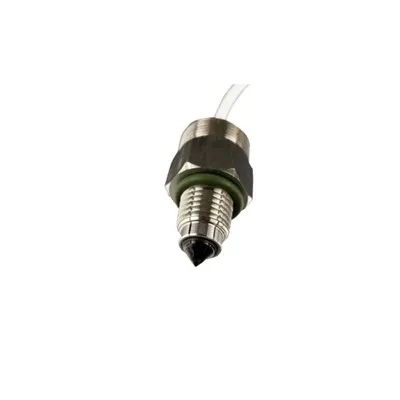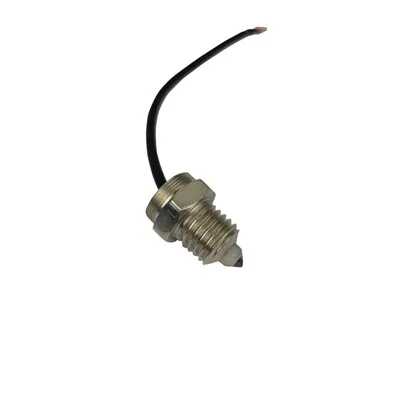
Optical Dissolved Oxygen Sensors - Principles of Operation
A complete guide to optical dissolved oxygen (DO) sensors: what dissolved oxygen is and the Henry's law + temperature/salinity physics behind it, why DO matters (wastewater, aquaculture, environment, biotech), the optode structure (sensing foil, optical window, blue LED, photodetector, thermistor), the Stern-Volmer luminescence quenching principle and why lifetime/phase measurement beats intensity, the optical vs electrochemical (Clark/galvanic) comparison, calibration and temperature compensation, the applications, the FAQ, and the bottom line.
Optical Dissolved Oxygen Sensors - Quick Answer
An optical dissolved oxygen (DO) sensor measures the oxygen gas dissolved in water using luminescence quenching - the same Stern-Volmer physics as optical gas-phase oxygen sensors, applied through a sensing foil that glows and is dimmed by O₂. A blue LED excites a ruthenium-based dye in a gas-permeable foil on the probe's window; oxygen diffuses through the foil and quenches the red luminescence; the sensor measures the lifetime/phase shift of the luminescence (not just its brightness), which maps directly to oxygen concentration via the Stern-Volmer equation, τ₀/τ = 1 + K_SV·[O₂], with a thermistor correcting for temperature. Because the dye is quenched but not consumed, the sensor measures O₂ without consuming it - no flow requirement, no stirring, minimal drift, and no membranes or electrolytes to replace (the foil lasts about 1–2 years). That makes optical DO sensors the low-maintenance standard for wastewater aeration control, aquaculture, environmental monitoring, and biotech - replacing membrane-covered electrochemical (Clark/galvanic) cells that consume oxygen, need flow, and drift. (The gas-phase sister principle: Sensing Principle of Oxygen Sensors.)
What Is Dissolved Oxygen?
The Physics of O₂ in Water
The basics:
| Term | Meaning |
|---|---|
| DO | O₂ gas dissolved in water |
| Units | mg/L (ppm) and % saturation |
| Henry's law | Solubility ∝ partial pressure |
| Temperature | Colder water holds more O₂ |
| Salinity/pressure | Salt and altitude lower solubility |
A gas dissolved in liquid: Dissolved oxygen is molecular O₂ dispersed between water molecules - the oxygen that fish breathe and that wastewater bacteria need. It is measured in mg/L (ppm) and as % saturation (the ratio to what water can physically hold at that temperature, salinity, and pressure). Henry's law governs it: gas solubility is proportional to the gas's partial pressure above the water, which is why aeration pumps air in and why altitude lowers saturation. Temperature dominates: cold water holds far more oxygen than warm - about 14.6 mg/L at 0 °C, 9.1 mg/L at 20 °C, and 7.6 mg/L at 30 °C in fresh water at 1 atm. Salinity lowers solubility (seawater holds ~20% less than fresh), and atmospheric pressure adds the altitude effect. Every DO reading is only meaningful with temperature (and ideally salinity/pressure) attached - which is exactly why DO sensors embed a thermistor. (The same "context makes the reading" logic as level and temperature measurement: What Is a Liquid Level Sensor?)
Why Measure DO?
The Real Jobs
Who needs the number:
| Application | Why DO Matters |
|---|---|
| Wastewater treatment | Aeration control - oxygen for bacteria |
| Aquaculture | Fish need ≥ ~4–5 mg/L (species-dependent) |
| Environmental monitoring | River/lake health, hypoxia alerts |
| Biotech / pharma | Fermentation oxygen control |
| Brewing / food | Process and product quality |
| Lab / BOD testing | Standard analytical measurement |
Six industries, one number: Wastewater treatment is the biggest consumer - activated-sludge bacteria need oxygen to digest organic matter, and aeration blowers are typically the plant's largest energy cost, so DO sensors close the control loop that saves megawatt-hours. Aquaculture keeps fish alive: most species need roughly 4–5 mg/L or more, and a sensor triggers aerators before a die-off. Environmental agencies monitor rivers and lakes for hypoxia (low-oxygen dead zones). Bioreactors in pharma and biotech control fermentation oxygen precisely. Breweries and food plants track DO for quality. Laboratories run BOD (biological oxygen demand) tests with DO meters. In every case, the sensor's reliability and maintenance burden decide how tightly - and how cheaply - the loop can run. (Application-thinking: Gas & Liquid Sensor Solutions.)
The Optode Structure
What's Inside the Probe
The anatomy:
| Component | Role |
|---|---|
| Sensing foil | Dye in gas-permeable matrix |
| Optical window | Transparent contact to water |
| Blue LED | Excitation light source |
| Photodetector | Reads red luminescence |
| Thermistor | Temperature compensation |
Five parts, one probe: The heart of an optical DO sensor - an "optode" - is a sensing foil: a luminescent dye (typically a ruthenium complex, sometimes platinum-based) immobilized in a gas-permeable sol-gel or silicone matrix, bonded to an optical window that contacts the water. Behind the window, a blue LED fires excitation light at the dye, and a photodetector (photodiode) reads the red luminescence that comes back. A thermistor measures water temperature for compensation. The foil is the only replaceable part, and the electronics are the same family as any optical sensor - LED, detector, conditioning, output. Oxygen diffuses through the foil, meets the excited dye molecules, and quenches their luminescence - the more O₂, the dimmer and shorter-lived the glow. (Component logic: Basic Components of a Temperature Sensor; the schematic family: Schematic of the Liquid Level Optical Sensor.)
The Sensing Principle: Stern-Volmer Quenching
Light That Dies Faster
The governing equation:
| Form | Equation | Meaning |
|---|---|---|
| Intensity | I₀ / I = 1 + K_SV · [O₂] | Brightness ratio |
| Lifetime | τ₀ / τ = 1 + K_SV · [O₂] | Decay-time ratio |
| K_SV | Stern-Volmer constant | Sensitivity of the dye |
| τ | Luminescence lifetime | ~µs class |
The dye's glow is the sensor: When the blue LED excites the dye, the dye emits red luminescence that decays with a characteristic lifetime (microsecond class). Oxygen molecules diffusing through the foil collide with excited dye molecules and steal the energy - quenching the luminescence. The Stern-Volmer equation describes the result in two equivalent forms: the intensity ratio I₀/I = 1 + K_SV·[O₂] (how much dimmer) and the lifetime ratio τ₀/τ = 1 + K_SV·[O₂] (how much shorter-lived). More O₂ → dimmer, faster-decaying glow → higher dissolved oxygen. Because the dye is only quenched and not consumed, the probe measures without consuming oxygen - the fundamental advantage over electrochemical cells. (The gas-phase sister: Sensing Principle of Oxygen Sensors - optical section.)
Lifetime vs Intensity
Why Phase Shift Wins
The measurement comparison:
| Aspect | Intensity | Lifetime / Phase |
|---|---|---|
| Signal | Brightness level | Decay time / phase lag |
| Fouling | Affected (dimmer) | Not affected |
| LED drift | Affected | Not affected |
| Dye aging | Affected | Not affected |
| Winner | Simple, cheap | Robust - used by real sensors |
Measure the time, not the brightness: In principle the sensor could read luminescence intensity - but brightness is corrupted by everything that dims light: fouling on the window, LED aging, dye bleaching, and dirt. Real optical DO sensors therefore excite the dye with an amplitude-modulated (or pulsed) blue LED and measure the phase shift / lifetime of the returned red luminescence - how much the glow lags the excitation, and how fast it decays. Lifetime is a property of the dye–oxygen interaction, not of how much dye is there or how bright the LED is, so fouling, aging, and drift barely affect it. This is why the lifetime/phase form of the Stern-Volmer equation is the one that matters in practice: it makes the sensor genuinely low-maintenance, needing calibration only occasionally instead of before every use. (The same "robust measurement beats convenient measurement" trade as hysteresis in level sensors: Schematic of the Liquid Level Optical Sensor.)
Optical vs Electrochemical DO
The Two Families Compared
Why optical replaced Clark cells in most roles:
| Aspect | Optical (optode) | Electrochemical (Clark/galvanic) |
|---|---|---|
| O₂ consumption | None | Consumes O₂ |
| Flow requirement | None (stirring not needed) | Needs flow over membrane |
| Drift | Minimal | Drifts (membrane/electrolyte) |
| Maintenance | Foil ~1–2 years | Membranes, electrolyte, anodes |
| Warm-up | None | Polarization time |
| Calibration | Occasional | Frequent |
| Cost | Higher upfront | Lower upfront |
The low-maintenance revolution: The membrane-covered Clark cell (and its self-powered galvanic cousin) has measured DO for decades: oxygen diffuses through a membrane and is reduced at a cathode, generating a current. It works - but it consumes the oxygen it measures, so it needs the water to flow over the membrane (stirring artifacts), it drifts as the membrane and electrolyte age, it needs polarization warm-up, and it demands regular membrane/electrolyte maintenance. The optical optode measures without consuming, needs no flow (it reads the true concentration even in still water), drifts minimally, warms up instantly, and only needs its foil replaced every ~1–2 years. The cost is a higher upfront price. For wastewater, aquaculture, and environmental duty - where reliability and low maintenance dominate - optical has become the default; Clark cells survive where budget or high-temperature/aggressive chemistry favors them. (The same "no-moving-parts reliability" logic: Liquid Level Sensors with No Moving Parts.)
Calibration and Temperature Compensation
Two Points and a Thermistor
The calibration recipe:
| Point | Method | Meaning |
|---|---|---|
| 100% sat | Air-saturated water / moist air | Full-scale reference |
| 0% | Sodium sulfite solution / N₂ | Zero reference |
| Temperature | Built-in thermistor | Solubility correction |
Two points, then trust the thermistor: Because DO solubility changes dramatically with temperature - 14.6 mg/L at 0 °C versus 7.6 mg/L at 30 °C - every DO reading is temperature-corrected by the built-in thermistor, and the sensor is calibrated at two points. The 100% saturation point is done in air-saturated water (or water-saturated air, which has the same O₂ partial pressure) - this sets the full scale for the current temperature, salinity, and pressure. The 0% point uses an oxygen-scavenging solution (sodium sulfite) or nitrogen gas - this sets the zero. Optical sensors hold calibration far longer than electrochemical cells, so the routine is occasional rather than daily; the foil's age and the drift the user tolerates set the schedule. Always record temperature (and salinity/pressure where relevant) with every DO value - a number without its conditions is meaningless. (Calibration thinking: Sensor Data Sheet: How to Read and Use One.)
Applications
Where Optical DO Wins
The installed base:
| Sector | Why Optical |
|---|---|
| Wastewater aeration | Low maintenance, loop control |
| Aquaculture | No flow needed, reliable alarms |
| Environmental | Long-term unattended logging |
| Biotech / pharma | Sterile, no O₂ consumption |
| Lab / BOD | Stability, easy calibration |
Five sectors, one reason - maintenance: Wastewater plants run optical DO probes in aeration basins year-round; the low drift and rare calibration let the blower control loop stay tight with minimal labor. Aquaculture likes that optical probes read correctly in still tanks and ponds - no stirring artifact - and alarm reliably before oxygen crashes. Environmental monitoring parks sensors in rivers and lakes for months of unattended logging. Biotech and pharma appreciate sterile probes that consume no oxygen from a precious culture. Laboratories use the stability for BOD and routine analysis. In every case the same physics - quenching without consumption, lifetime measurement without fouling sensitivity - is what makes the sensor affordable to own, not just to buy. (Application method: Guide to Liquid Level Sensors.)
FAQ
Q1: How does an optical dissolved oxygen sensor work?
It uses luminescence quenching (Stern-Volmer). A blue LED excites a ruthenium-based dye in a gas-permeable foil on the probe's window; oxygen diffuses through the foil and quenches the red luminescence. The sensor measures the lifetime/phase shift of the glow, which follows τ₀/τ = 1 + K_SV·[O₂], and a thermistor corrects for temperature. More O₂ means a dimmer, shorter-lived glow. Because the dye is quenched but not consumed, the sensor measures without consuming oxygen.
Q2: What is the difference between optical and electrochemical DO sensors?
Electrochemical (Clark/galvanic) sensors consume the oxygen they measure, so they need flow over the membrane, drift as membrane and electrolyte age, require polarization warm-up, and need regular membrane/electrolyte maintenance. Optical optodes consume nothing, need no flow, drift minimally, warm up instantly, and only need the foil replaced every ~1–2 years. Optical sensors cost more upfront; electrochemical sensors cost less but cost more to maintain.
Q3: Why do optical DO sensors measure lifetime instead of brightness?
Because brightness is corrupted by everything that dims light - fouling, LED aging, dye bleaching - while lifetime is a property of the dye–oxygen interaction. By modulating the blue LED and measuring the phase shift / decay time of the returned luminescence, the sensor reads a quantity unaffected by fouling and aging. That is what makes optical DO sensors genuinely low-maintenance: the measurement survives a dirty window.
Q4: How do you calibrate an optical dissolved oxygen sensor?
At two points. The 100% saturation point uses air-saturated water (or water-saturated air, which has the same oxygen partial pressure) to set full scale at the current temperature, salinity, and pressure. The 0% point uses an oxygen-scavenging solution like sodium sulfite (or nitrogen gas). The built-in thermistor corrects every reading for temperature - DO solubility falls from ~14.6 mg/L at 0 °C to ~9.1 mg/L at 20 °C and ~7.6 mg/L at 30 °C in fresh water. Optical sensors hold calibration far longer than Clark cells.
Q5: What are the main uses of dissolved oxygen sensors?
Wastewater treatment (aeration control - the biggest use), aquaculture (keeping fish alive above ~4–5 mg/L), environmental monitoring (river and lake hypoxia), biotech and pharma (fermentation oxygen control), brewing and food (quality), and laboratory BOD testing. Optical DO sensors dominate the first four because low maintenance and low drift make the control loops and long-term logs affordable.
The Bottom Line
An optical dissolved oxygen sensor is the liquid application of the optical oxygen-sensing principle: a blue LED excites a ruthenium dye in a gas-permeable foil, oxygen quenches the red luminescence, and the sensor reads the lifetime/phase shift - τ₀/τ = 1 + K_SV·[O₂] - with a thermistor for temperature compensation. Measuring lifetime instead of brightness makes the reading immune to fouling, LED drift, and dye aging - which is why the optode needs no flow, no stirring, minimal calibration, and only a foil replacement every ~1–2 years. That maintenance advantage is what displaced the membrane-covered Clark cell in wastewater aeration, aquaculture, environmental monitoring, and biotech: no oxygen consumption, no drift, no warm-up. The physics of dissolved oxygen itself - Henry's law, the fall from ~14.6 mg/L at 0 °C to ~7.6 mg/L at 30 °C, and salinity/pressure effects - means every reading carries its temperature with it. If you understand Stern-Volmer quenching and the signal chain behind an optical sensor, you already understand the optode: one dye, one LED, one photodetector, one thermistor - and a foil that quietly dims with every breath of oxygen. (Oxygen physics: Sensing Principle of Oxygen Sensors; sensor anatomy: Basic Components of a Temperature Sensor.)
Last updated: August 2026
Disclaimer: This article is an educational guide to the principles of operation of optical dissolved oxygen sensors for general reference. The governing physics and typical values (Stern-Volmer quenching, I₀/I = 1 + K_SV·[O₂] and τ₀/τ = 1 + K_SV·[O₂]; dissolved oxygen saturation ~14.6 mg/L at 0 °C, ~9.1 mg/L at 20 °C, ~7.6 mg/L at 30 °C in fresh water at 1 atm; Henry's law; optical vs electrochemical maintenance characteristics; foil lifetime ~1–2 years; two-point calibration with air-saturated water and sodium sulfite) are established scientific and engineering knowledge; specific values, foil lifetimes, accuracies, and calibration procedures vary by manufacturer and model and must be confirmed on the official data sheet. This guide is not affiliated with any sensor manufacturer.