What Is the Best Way to Measure the Liquid Level in a Tank?
The most common question engineers ask when specifying a tank-level system is also the most deceptively simple: what is the best way to measure the liquid level in a tank? The honest answer is that there is no single "best" sensor - there is only the best sensor for your specific tank, liquid, and control objective. A float switch that is perfect for a rooftop water tank will fail in a pressurized hydrochloric acid reactor. A radar transmitter that excels in a tall silo is overkill for a 30 cm coolant reservoir.
This guide gives you the decision framework to answer the question correctly for your application. We start with the single most important distinction - point-level vs continuous measurement - then compare the leading technologies, and finish with a practical selection matrix you can apply to any tank.
Step 1: Point-Level or Continuous-Level Measurement?
Before comparing sensor types, you must define what "measure the level" actually means in your system. This determines the entire technology path.
Point-level detection answers a yes/no question: Is the liquid at a specific height? You need this for pump control (turn the pump on/off at a threshold), high-level alarm, or dry-run protection. The right product is a level switch - float, optical, vibrating fork, or conductive.
Continuous-level measurement answers a different question: Exactly how full is the tank, right now? You need this for inventory tracking, dosing control, flow totalization, or any system where the controller must know the actual percentage fill. The right product is a level transmitter - radar, ultrasonic, hydrostatic, magnetostrictive, or capacitive.
If you only need to know when the tank is full or empty, a level switch is cheaper, simpler, and more reliable. If you need to know how much is in the tank at all times, you need a transmitter. Many modern tanks use both: a transmitter for inventory plus a float or optical switch as an independent high-level safety backup.
For a deeper breakdown of this distinction, see our guide to continuous vs point-level sensors.
Step 2: The Leading Tank-Level Technologies Compared
1. Hydrostatic / Pressure Level Measurement
A hydrostatic transmitter measures the pressure exerted by the liquid column above the sensor, then converts it to level using the relationship level = pressure ÷ (density × gravity). The sensor is mounted at or near the tank bottom, immersed in the liquid.
Best for: water, wastewater, oils, fuels, and most non-foaming liquids in open or closed tanks
Strengths: high accuracy (±0.1–0.5% FS), low cost, unaffected by foam, vapor, or turbulence at the surface, works in pressurized tanks
Limitations: requires known and stable liquid density; cannot measure level above the sensor; wetted diaphragm is exposed to the full process medium; not ideal for liquids with changing concentration
Key variant: submersible level probe (dropped into a stilling tube or directly into the liquid) for deep wells and open channels
Hydrostatic measurement is often the most cost-effective way to measure liquid level in a tank when the liquid density is stable and the medium is not aggressively corrosive. See our dedicated guide on measuring liquid level with pressure sensors.
2. Ultrasonic Level Measurement
An ultrasonic sensor mounted above the liquid sends a sound pulse and times its return echo. Distance to surface = (speed of sound × time) ÷ 2. Level is then derived from tank height minus that distance.
Best for: water, chemicals, and bulk liquids in open or vented tanks
Strengths: non-contact (sensor never touches the liquid), no moving parts, easy to install through a top nozzle
Limitations: performance degraded by heavy foam, vapor, dust, or turbulent surfaces; speed of sound varies with temperature (requires temp compensation); narrow beam needs careful aiming; not for vacuum or high-pressure vessels
Note: For intrinsically safe installations, specialized intrinsically safe ultrasonic level sensors are required
Ultrasonic is an excellent general-purpose choice for clean, vented tanks but should be avoided where heavy foam or condensation on the transducer is expected.
3. Radar Level Measurement (Non-Contact and Guided-Wave)
Radar transmits a microwave signal and measures the time-of-flight or frequency shift of the reflection from the liquid surface.
Non-contact radar (free-space): antenna mounted at tank top; ideal for corrosive, high-temperature, or hygienic applications where the sensor must not touch the product
Guided-wave radar (GWR): a probe (rod or cable) extends into the liquid; the microwave travels along the probe. Far more immune to foam, vapor, and agitation than ultrasonic
Best for: chemicals, hydrocarbons, steam, aggressive media, and difficult surfaces (foam, turbulence, dust)
Strengths: unaffected by temperature, pressure, vapor, or density changes; very high accuracy; works in vacuum and high pressure; low maintenance
Limitations: higher capital cost; free-space radar can struggle with still surfaces or very low dielectric fluids; GWR probe can foul in sticky media
Radar is frequently the best technology for difficult industrial liquids - but its cost is hard to justify for a simple water tank.
4. Magnetostrictive (Float-on-Shaft) Continuous Measurement
A float containing a permanent magnet rides on a sealed stem; a magnetostrictive wire inside the stem detects the float's position with extremely high precision, outputting 4–20 mA or digital.
Best for: clean liquids requiring high-resolution measurement - hydraulics, lube oil, precision dosing, mobile equipment
Strengths: very high accuracy (±0.5 mm typical), excellent repeatability, long service life, robust in mobile/hydraulic environments
Limitations: float must move freely along the stem (no fouling or coating); not for viscous or crystallizing media; higher cost than hydrostatic
5. Capacitive / RF Admittance Continuous Measurement
A probe acts as one plate of a capacitor; the liquid changes the dielectric between probe and tank wall. Electronics convert the capacitance change to level.
Best for: liquids and some solids where the dielectric contrast is sufficient; coating-tolerant variants (RF admittance) handle sticky media
Strengths: works in non-metallic tanks, simple probe design, tolerant of some coating
Limitations: accuracy depends on dielectric stability of the product; conductive coatings can cause drift; more setup-sensitive than radar
6. Float Level Switch (Point-Level)
The classic buoyant float actuates a reed or micro-switch at a set level. Covered in detail in our float level switch product types guide.
Best for: simple pump control and alarm in water, oil, and chemical tanks
Strengths: inexpensive, fail-safe, no power needed to operate the float mechanism, easy to understand
Limitations: only point-level; moving parts wear; needs adequate SG (specific gravity) margin
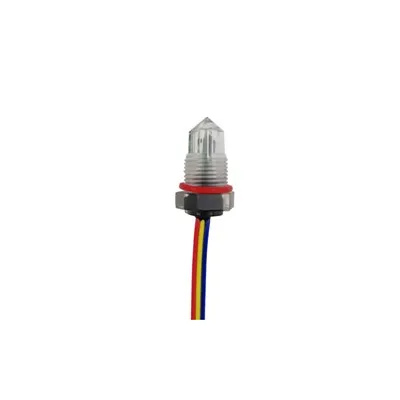
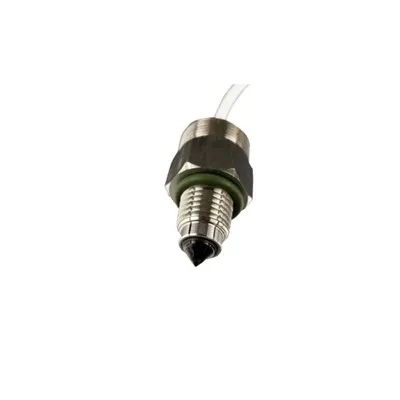
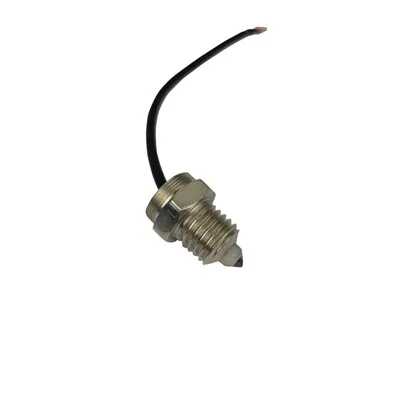
7. Optical Level Switch (Point-Level, No Moving Parts)
An infrared LED and photodetector sit in a prism at the tank wall. Presence or absence of liquid changes the light path; the switch changes state in milliseconds.
Best for: clear liquids, compact spaces, hygienic and electronics-grade applications
Strengths: no moving parts, fastest response of any point-level switch, tiny footprint, no calibration
Limitations: single point only; prism must stay clean; not for opaque or heavily coated media
8. Vibrating Fork Level Switch (Point-Level)
A fork vibrates at its resonant frequency; when liquid surrounds the fork, damping changes and the switch trips.
Best for: point-level in viscous, coating, or turbulent liquids where floats and optics foul
Strengths: immune to foam, buildup, and turbulence; robust in harsh service; no calibration
Limitations: single point; larger than optical; not for very light powders
Step 3: The Selection Matrix - Best Method by Application
Use this matrix to move from "what is the best way?" to "which sensor should I specify?"
| Application | Recommended Primary Method | Why | Backup / Safety |
|---|---|---|---|
| Potable / clean water tank (vented) | Ultrasonic or hydrostatic | Low cost, accurate, easy install | Float switch for high-level alarm |
| Wastewater / sewage | Hydrostatic (submersible) or GWR | Tolerant of foam, sludge, turbulence | Float or vibrating fork high alarm |
| Hydrocarbon / fuel storage | Guided-wave radar or magnetostrictive | Non-contact or high-res; safe in hydrocarbons | Float switch (IS if hazardous) |
| Aggressive acid / chemical | Non-contact radar (PTFE antenna) | Sensor never touches product | Optical or IS float backup |
| High-pressure / steam vessel | Guided-wave radar or hydrostatic | Rated for pressure and temperature | Pressure-rated float (IS if needed) |
| Hygienic / food & pharma | Non-contact radar or magnetostrictive (polished) | Cleanable, no crevices | Optical point switch |
| Mobile hydraulics / lube oil | Magnetostrictive | High resolution, shock-resistant | Float switch low-level cutoff |
| Hazardous area (ATEX/IECEx) | IS radar, IS ultrasonic, or IS float | Certified for zone classification | Independent IS high-level switch |
| Small coolant reservoir (<1 m) | Optical or float point switch | Simple, compact, cheap | - |
| Foaming / turbulent process | Guided-wave radar or vibrating fork | Unaffected by surface condition | - |
Step 4: The Five Parameters That Decide "Best"
Whatever tank you are measuring, lock down these five parameters before choosing - they eliminate most candidates immediately:
Is the tank open, vented, or pressurized? Pressurized and vacuum service rules out most ultrasonic and many float designs.
What is the liquid (name, concentration, SG)? Density stability decides whether hydrostatic works; SG decides float buoyancy; chemistry decides wetted material.
What is the surface condition? Foam, turbulence, vapor, or dust immediately disqualify ultrasonic and favor radar or GWR.
What accuracy and resolution do you need? Inventory tracking may need ±1 mm (magnetostrictive/radar); pump control only needs a threshold (float/optical).
What is the area classification? Hazardous locations require ATEX/IECEx-certified devices and matching barriers.
The method that survives these filters and fits your budget is the best way to measure the level in your tank.
Common Mistakes When Choosing a Tank-Level Method
Specifying a transmitter when a switch would do. A 4–20 mA radar transmitter is a poor value for a sump pump that only needs to start and stop. Match the complexity of the measurement to the control task.
Using ultrasonic in a foaming tank. Foam absorbs and scatters the sound pulse, producing erratic or stuck readings. Guided-wave radar or a vibrating fork will be far more reliable.
Forgetting density in hydrostatic measurement. Hydrostatic level is density-dependent. If the liquid concentration varies (e.g., sugar solution, brine), the calculated level drifts unless the transmitter is density-compensated or you accept the error.
Ignoring hazardous-area certification. Installing a non-certified switch in a Zone 1 fuel tank is both unsafe and non-compliant. Confirm zone, gas group, and temperature class against the device certificate.
Overlooking the backup safety layer. Best practice for overfill protection is a separate independent level device (often a simple float or optical switch) that is not part of the primary control loop - so a single failure cannot cause an overflow.
FAQ: Measuring Tank Liquid Level
What is the most accurate way to measure liquid level in a tank?
For absolute accuracy, guided-wave radar and magnetostrictive transmitters lead, typically within ±1 mm to ±2 mm. Radar is best for harsh or non-contact service; magnetostrictive is best for clean hydraulic and dosing applications. Hydrostatic pressure is very accurate (±0.1–0.5% FS) and far cheaper, but only when liquid density is stable.
Can I measure tank level without opening or penetrating the tank?
Yes. Non-contact radar and ultrasonic sensors mount on the outside of the tank top through a nozzle and never touch the liquid. External clamp-on sensors exist for specific pipe/tank geometries, but for most tanks a top-mounted non-contact transmitter is the standard "no penetration" solution.
What is the cheapest reliable way to measure level?
For point-level control (pump on/off, alarm), a float switch or optical level switch is the lowest-cost reliable option. For continuous measurement on stable-density liquids, a hydrostatic pressure transmitter is usually the most economical accurate choice.
Which method works best for water tanks specifically?
For a vented potable water tank, ultrasonic (non-contact, no fouling) or hydrostatic submersible probe (low cost, foam-proof) are both excellent. A float switch handles pump control as a low-cost backup. Our water-level sensor comparison covers this in depth.
How do I measure level in a hazardous (explosive) area?
You must use devices certified for the specific zone and gas group - intrinsically safe radar, ultrasonic, or float switches with matched barriers. Standard non-certified sensors are prohibited. See our hazardous-location level guide for the certification vocabulary.
Is radar better than ultrasonic for tanks?
For difficult conditions - foam, vapor, pressure, dust, or aggressive media - radar (especially guided-wave) is clearly better. For a clean, vented, atmospheric tank with a stable surface, ultrasonic is usually the better value. Radar wins on robustness; ultrasonic wins on cost.
Conclusion
There is no universal "best" way to measure the liquid level in a tank - only the best method for your tank's pressure, your liquid's properties, your required accuracy, and your area classification. Start by deciding whether you need point-level or continuous measurement, then apply the five-parameter filter above. For most water and wastewater tanks, hydrostatic or ultrasonic measurement is the smart, economical choice. For aggressive, foaming, pressurized, or hazardous service, guided-wave radar is typically the most reliable. And regardless of primary method, add an independent level switch as a safety backup for overfill protection.
The right answer is the one that matches the physics of your tank to the capability of the sensor - and that is exactly what the selection matrix in this guide is built to deliver.
For a full technology reference, see our ultimate guide to liquid level switches and the level sensor selection guide. For method-specific deep dives, explore measuring level with pressure sensors and continuous vs point-level sensors.