Which Sensor Is Used to Detect Water?
In this guide: The honest answer to "which sensor detects water," why the right sensor depends on the job (leak vs. level vs. moisture), why water is both the easiest and trickiest liquid to detect, the critical pure-water trap that defeats conductive probes, a full comparison of the main water sensors, the best sensor by application, selection factors, installation notes, and the complete FAQ.
Which Sensor Is Used to Detect Water? - Quick Answer
It depends on the job - but the sensors that detect water most reliably are optical (total-internal-reflection) and capacitive, because they work on any water including pure/deionized water. For a simple "is water present?" or leak alarm, an optical TIR point sensor or a capacitive probe is preferred. For water level, float, optical, ultrasonic, or pressure sensors all work. The one to avoid for unknown water is a conductive probe - it only works because real water contains ions; pure or deionized water barely conducts, so a conductive sensor can miss it entirely. Optical and capacitive don't care about conductivity, which is why they are the safe default for "detect water."
What "Detect Water" Means
Three Different Jobs
Clarify the goal:
| Goal | Question | Typical Sensor |
|---|---|---|
| Presence / leak | "Is water here?" | Optical, capacitive |
| Level | "How much water?" | Float, optical, ultrasonic, pressure |
| Moisture | "How wet?" | Capacitive moisture |
Presence, level, or moisture: "Detect water" can mean spotting a leak (is water on the floor?), measuring how full a tank is, or gauging moisture in soil or air. Each points to a different sensor family. A leak alarm wants a point yes/no; a tank wants continuous level; a plant pot wants a moisture percentage. Knowing which of the three you mean decides the sensor - but the underlying "how do we sense water at all?" question has one key answer below. (Level detail: Which Sensors Can Be Used for Water Level Measurement.)
Why Water Is Special
Easy to See - With the Right Method
Water's telltale properties:
| Property | Water | Why It Matters |
|---|---|---|
| Conductive? | Only if impure | Conductive probes fail on pure water |
| Dielectric (εr) | ~80 | Capacitive sees it strongly |
| Refractive index | ~1.33 | Optical TIR flips at the tip |
| Density | 1000 kg/m³ | Pressure P = ρgh works |
The double-edged liquid: Water is the easiest liquid to detect and the one that trips up the obvious sensor. It conducts electricity only because of dissolved ions - tap, rain, and sea water conduct, but pure/deionized water is a poor conductor. That breaks the naive "water = conducts, so use two wires" assumption. But water also has a very high dielectric constant (~80) and a refractive index (~1.33), so capacitive and optical sensors read it unmistakably regardless of purity. Pick the method that keys off dielectric or refraction, not conductivity, and water is trivial to detect. (Pure-water trap: Optical Infrared Water Liquid Level Sensor.)
The Main Water Sensors Compared
What Actually Works
Candidate sensors:
| Sensor | Detects By | Pure Water? | Notes |
|---|---|---|---|
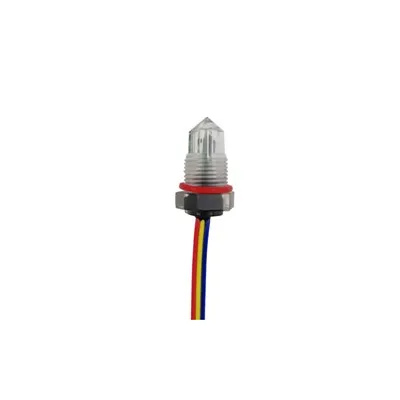
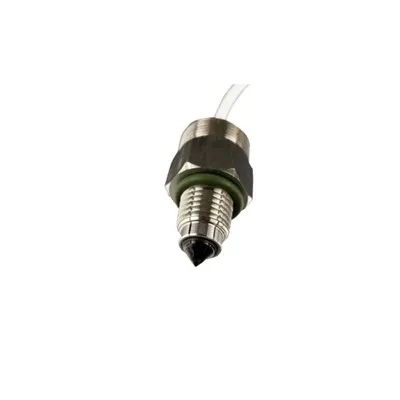
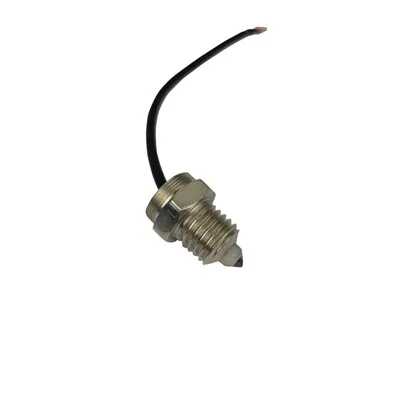
| Optical (TIR) | Light reflection at tip | ✅ Yes | Sealed, any liquid |
| Capacitive | Dielectric change | ✅ Yes | Through-wall possible |
| Conductive | Electrical conduction | ❌ No (impure only) | Cheap, corrodes |
| Float | Buoyancy | ✅ Yes | Mechanical, simple |
| Ultrasonic | Sound echo | ✅ Yes | Non-contact level |
| Pressure | Hydrostatic P = ρgh | ✅ Yes | Needs known density |
Rank by reliability: Optical TIR and capacitive are the most reliable because they detect water by physics that doesn't depend on purity - optical flips its output when liquid wets the sealed tip (dry = total internal reflection, wet = refraction escapes), and capacitive sees water's huge dielectric constant. Float works by buoyancy on any water but has moving parts. Ultrasonic and pressure measure level non-contact or by head. Conductive is the risky one: it only closes a circuit when water conducts, so it silently fails on pure water and corrodes in use. (Comparison: What Sensors Indicate Liquid Level.)
The Pure-Water Trap
Why Conductive Probes Miss Water
The failure mode:
| Water Type | Conducts? | Conductive Sensor |
|---|---|---|
| Tap water | Yes (ions) | ✅ Works |
| Rain / sea | Yes | ✅ Works |
| Pure / DI | Barely | ❌ Fails |
| Distilled | Barely | ❌ Fails |
Don't bet on conductivity: A conductive (resistive) water sensor assumes water completes a circuit between two electrodes. That is only true when ions are present. Tap, rain, and seawater conduct and trip the sensor; pure, distilled, or deionized water does not, so the sensor reads "dry" even with water sitting on it. In laboratories, humidifiers, and RO/DI systems, that mistake is common and dangerous (a leak goes undetected). Optical and capacitive sensors have no such blind spot - they detect the water molecule itself, not its ions. This is the single most important point when choosing "a water sensor." (Mechanism: How Sensors Detect Water Level.)
Best Sensor by Application
Match the Job
Quick mapping:
| Application | Preferred Sensor |
|---|---|
| Leak / flood alarm | Optical TIR point (or capacitive) |
| Tank / sump level | Float, optical, ultrasonic, pressure |
| Soil / pot moisture | Capacitive moisture |
| Rain detection | Optical or resistive (rain is conductive) |
| Boiler / HVAC | Pressure (or float) |
| Pure-water system | Optical or capacitive (never conductive) |
Pick by context: For a leak or flood alarm, an optical TIR point sensor is the safe default - sealed, any water, no corrosion. For tank or sump level, float (cheap), optical (sealed), ultrasonic (non-contact), or pressure (submerged) all fit. For soil or pot moisture, a capacitive moisture probe is standard. Rain is conductive, so a simple resistive rain sensor works. In any pure-water or DI system, insist on optical or capacitive and never a conductive probe. The application tells you the family; water's properties tell you which to trust. (Leak use: Optical Liquid Point Level Sensors.)
Selection Factors
Choosing the Right Water Sensor
Checklist:
| Factor | Points To |
|---|---|
| Pure water? | Optical or capacitive (not conductive) |
| Presence or level? | Point vs continuous |
| Container | Non-metal for through-wall |
| Corrosive? | Optical / capacitive (sealed) |
| Moving parts OK? | Float adds wear |
| Budget | Float / conductive cheapest |
Settle six things: Is the water pure (then optical/capacitive, never conductive)? Do you need presence or level? Is the container metal (blocks capacitive through-wall)? Is it corrosive (favor sealed optical/capacitive)? Are moving parts acceptable (float wears)? What is the budget (float and conductive are cheapest but limited)? Answer these and the sensor chooses itself. (Buyer's view: Optical Level Sensors Buyers Guide.)
Installation Notes
Get a Clean Signal
Practical tips:
| Sensor | Tip |
|---|---|
| Optical | Keep tip clean; position at alarm height |
| Capacitive | Flush to non-metal wall, no air gap |
| Conductive | Two electrodes, avoid electrolysis (AC) |
| Float | Free travel, no snag |
| Ultrasonic | Vertical, clear of dead zone |
| Pressure | Vent to atmosphere, known density |
Per-sensor care: Optical tips must stay clean (coating mimics or blocks wetting). Capacitive pads mount flush on a non-metal wall with no air gap (metal shields the field). Conductive probes should use low AC excitation to limit electrolysis and corrosion. Floats need free travel. Ultrasonic transducers mount vertical and clear of the dead zone. Pressure transmitters must be vented to atmosphere (or use a sealed gauge reference) and assume known water density. Small setup details decide whether the reading is honest. (See Measuring Water Level With Ultrasonic Sensor: 7 Steps.)
Applications
Where Water Detection Lives
| Application | Use |
|---|---|
| Leak / flood | Basement, under-appliance, server room |
| Tank / cistern | Fill level, pump control |
| Sump | Dry-run / overflow |
| Soil / agriculture | Irrigation moisture |
| Appliance | Washer, dishwasher, coffee |
| Pure-water / lab | RO/DI leak, never conductive |
Everywhere water can leak or run out: Water detection guards basements and server rooms from leaks, controls fill and pumps in tanks and cisterns, protects sumps from dry-run and overflow, tunes irrigation by soil moisture, and sits inside washers, dishwashers, and coffee machines (often as a pressure switch - see Water Level Sensor on a Washing Machine). In labs and RO/DI systems, optical or capacitive leak detection is mandatory because conductive sensors fail on pure water. If water matters, a sensor belongs there. (Washer context: Water Level Sensor on a Washing Machine.)
Frequently Asked Questions
Q1: Which sensor is best to detect water?
For a simple "is water present?" or leak alarm, an optical (total-internal-reflection) point sensor or a capacitive probe is best, because both detect water by dielectric constant or refraction and work on any water - including pure/deionized water. For water level, float, optical, ultrasonic, or pressure sensors all work. Avoid a conductive probe unless you are certain the water is impure, because pure water does not conduct and the sensor will miss it.
Q2: Why does a conductive water sensor fail on pure water?
Because a conductive sensor only works when water completes an electrical circuit between two electrodes, and that requires dissolved ions. Tap, rain, and sea water contain ions and conduct; pure, distilled, or deionized water has almost none, so it reads as "dry" even when wet. Optical and capacitive sensors don't rely on conductivity - optical senses the refractive-index change at a sealed tip, and capacitive senses water's high dielectric constant - so they detect pure water reliably.
Q3: Can a capacitive sensor detect water through a wall?
Yes - capacitive sensing can read water through a non-conductive wall (plastic or glass) because the electric field penetrates the wall and the high dielectric constant of water changes the capacitance. This is ideal for sealed or dirty environments where you don't want electrodes in the water. It does not work through metal, which shields the field; there the probe must be inside the container (still fine, since capacitive has no exposed, corroding electrodes).
Q4: What sensor detects water level in a tank?
Several: a float switch (cheap, mechanical, any water), an optical TIR point sensor (sealed, any water), an ultrasonic transmitter (non-contact, times a sound echo to the surface), or a pressure transmitter (measures hydrostatic head P = ρgh). For continuous percentage level, ultrasonic or pressure is typical; for simple on/off control, float or optical point sensors are enough. Pure-water tanks should use optical or capacitive, not conductive.
Q5: Is an optical water sensor reliable on any liquid?
Yes. An optical TIR sensor decides by light behavior at a sealed tip - dry air reflects light back (no liquid), wet liquid refracts it away (liquid present). Because the decision is optical, not electrical, it works on water (including pure), oils, and most liquids alike; only the tip material must be compatible with the fluid. It is sealed (no moving parts, no electrodes in the liquid) and is a preferred general-purpose water (and liquid) detector. (Deep dive: How Optical Level Sensors Work.)
The Bottom Line
The sensors used to detect water are optical (TIR) and capacitive for presence/leak and any-water reliability, with float, ultrasonic, and pressure handling level - and the one to avoid for unknown water is a conductive probe, because pure/deionized water does not conduct and will be missed. Water is easy to detect by its high dielectric constant (~80) and refractive index (~1.33), so capacitive and optical sensors read it unambiguously regardless of purity; float works by buoyancy on any water; ultrasonic and pressure measure level by echo or hydrostatic head. Conductive probes only work on impure water and corrode, so they are the risky choice. Match the sensor to the job (leak → optical/capacitive point; level → float/optical/ultrasonic/pressure; moisture → capacitive) and, whenever purity is uncertain, trust optical or capacitive over conductivity.
Last updated: August 2026
Disclaimer: This guide explains water-detection sensor choice for educational purposes. Technical anchors used (optical TIR: dry = total internal reflection / wet = refraction escape; refractive index air ≈ 1.00, water ≈ 1.33, oil ≈ 1.46; capacitive C = ε₀εᵣA/d, dielectric constant water ≈ 80, air ≈ 1.0, dry waste low; capacitive non-contact through non-metal walls, blocked by metal; conductive probes require ions and fail on pure/distilled/deionized water; pressure P = ρgh; ultrasonic time-of-flight distance = speed × time ÷ 2) are established sensing facts drawn from the sensor cluster's verified articles. The pure-water caveat (conductive sensors miss DI water) is a well-known limitation. Verify specific sensor specifications, container-material compatibility, and applicable codes against official datasheets and standards before selection or installation. This guide is not affiliated with or sponsored by any manufacturer.